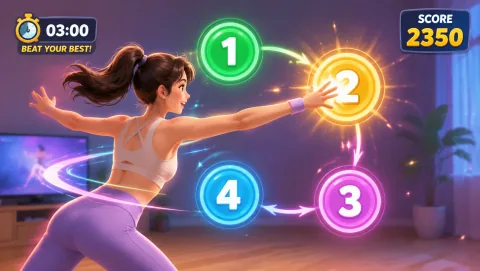
A motion game cannot use your body as a controller without seeing movement. The privacy question is what happens to those camera frames after the browser receives them.
For MovePlay, the current privacy policy states that gameplay video and skeletal tracking data are processed locally on the user’s device. They are not transmitted to MovePlay’s servers.
A feature is only valuable if it survives the real room and the real user. Explain camera handling, age fit, device and room requirements, changing plan details, and what repeat use looks like without hiding the trade-offs. Helping the wrong customer say no can make the right customer's yes more informed.
What “local processing” means
Your browser receives the camera stream and runs the tracking model on the device. The model estimates landmarks such as hands, shoulders, hips, or knees. The game then uses those estimated positions as controls.
The key point is that the motion-control loop can happen without sending raw gameplay video to a remote server.
A short trial in the real room is more informative than a long feature comparison on paper.
Buying content is most useful when it answers the questions a sales page cannot answer in one headline. Separate technical compatibility from enjoyment: a game can run perfectly and still be the wrong movement style for a particular child. Helping the wrong customer say no can make the right customer's yes more informed.
Does local processing mean the camera is always on?
No. The site still needs permission to access the camera when a camera-controlled game is running. Browser and operating-system permission controls remain in charge of that access.
You can revoke camera permission in your browser settings, and you should close the game when you are finished if you do not want the camera in use.
Families need enough information to decide that a product fits—or does not fit—their routine. Separate technical compatibility from enjoyment: a game can run perfectly and still be the wrong movement style for a particular child. Helping the wrong customer say no can make the right customer's yes more informed.
Trust grows when commercial content is willing to discuss limits. Separate technical compatibility from enjoyment: a game can run perfectly and still be the wrong movement style for a particular child. Helping the wrong customer say no can make the right customer's yes more informed.
What data is different from the camera stream?
A service may still collect ordinary website or account information separately from gameplay camera data—for example, account details, subscription records, or standard site analytics, depending on the current policy.
That is why “we do not upload camera video” should not be interpreted as “the service collects no data of any kind.” Read the full privacy policy for the current list.
What should schools and parents verify?
Before deployment, check:
- whether camera frames leave the device;
- whether recordings are stored;
- whether skeletal or landmark data is transmitted;
- whether children need individual accounts;
- what analytics or account data is collected;
- how permissions can be revoked;
- who to contact for privacy questions.
For schools, those answers should be documented before a teacher builds a lesson around the product.
Why this matters for motion games
Camera access is a higher-trust permission than clicking a button. A motion-game company should therefore explain its camera behavior in plain language, not bury it behind vague phrases such as “AI-powered tracking.”
MovePlay’s privacy model is easiest to understand when stated directly: the camera is used for real-time motion control, and the current policy says the gameplay camera stream and skeleton data stay on the device.
The second and third use tell you more about value than the first session. Separate technical compatibility from enjoyment: a game can run perfectly and still be the wrong movement style for a particular child. Helping the wrong customer say no can make the right customer's yes more informed.
Make the activity work in the real timetable
Best fit: use this when the teacher can explain one visible rule, keep the first turn brief, and give students a clear way to watch, lead, or pause without being singled out.
Limit: it is a poor fit when setup takes longer than the learning goal, the room cannot be reset safely, or the scoring rewards speed over control. A lower-tech version may teach the same idea better.
If you are choosing: If you are choosing between formats, begin with the option that needs the fewest materials and the least movement across the room. Test one round before committing the whole class.