A webcam game does not feel the force of a squat. It watches how body landmarks move in the camera image and applies a rule.
A browser motion game has several layers that can fail independently. Browser, operating system, device management, and network policy can all affect a setup that looked simple on a product page. Solve the specific bottleneck before adding more hardware.
The game first finds relevant landmarks
A pose model may estimate shoulders, hips, knees, and ankles in each frame.
The fastest technical fix usually comes from changing one variable at a time. Browser, operating system, device management, and network policy can all affect a setup that looked simple on a product page. Solve the specific bottleneck before adding more hardware.
A stable baseline is more useful than jumping straight to hardware upgrades. Browser, operating system, device management, and network policy can all affect a setup that looked simple on a product page. Solve the specific bottleneck before adding more hardware.
Webcam tracking is easiest to troubleshoot when the setup is reduced to basics. Start with permission, the correct camera, even lighting, clear framing, and a device that is not busy running several heavy tabs. That discipline makes motion tracking much less mysterious in practice.
It creates a reference posture
When the player is standing, the game can record relative body positions or use a general standing state as the baseline.
Motion tracking depends on the whole camera setup, not only the camera specification. Start with permission, the correct camera, even lighting, clear framing, and a device that is not busy running several heavy tabs. That discipline makes motion tracking much less mysterious in practice.
It watches for downward movement
As the player squats, hips and knees move into a different relationship. The game can measure body height, joint angles, or normalized landmark distances.
A browser motion game has several layers that can fail independently. Start with permission, the correct camera, even lighting, clear framing, and a device that is not busy running several heavy tabs. That discipline makes motion tracking much less mysterious in practice.
A threshold triggers the command:
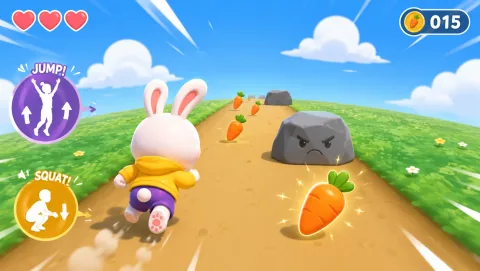
Once the movement passes a chosen threshold, the game may fire, duck, jump a character, or count one repetition.
It needs a reset state:
Good squat controls avoid counting repeatedly while the player stays low. The game waits for the player to rise before accepting another squat.
Why two people may trigger it differently
Body proportions, camera angle, squat depth, clothing, and framing vary. A robust game uses forgiving thresholds rather than treating the webcam as a clinical measurement tool.
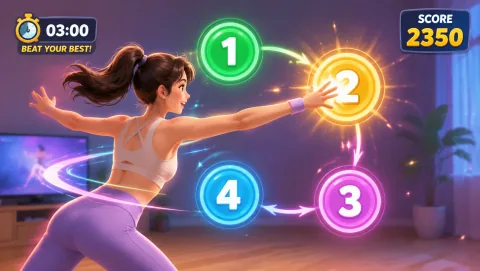
This is the basic pattern behind many motion controls: observe landmarks, define a meaningful change, add a threshold, and turn that change into gameplay.
The fastest technical fix usually comes from changing one variable at a time. Start with permission, the correct camera, even lighting, clear framing, and a device that is not busy running several heavy tabs. That discipline makes motion tracking much less mysterious in practice.
Judge the format by the device and the room
Best fit: start here when the device is already available, the camera view is understandable, and the activity can be completed without moving furniture or sharing more video than necessary.
Limit: it is a weaker choice when the connection is unstable, the frame is crowded, the light makes tracking unreliable, or the player needs a movement the camera cannot read consistently.
If you are choosing: If you are choosing between a digital and an offline version, test the first cue before choosing the game. Use the offline option when it gives clearer feedback or a more comfortable way to participate.