Adult and mixed-age house parties often need something between “everyone is talking comfortably” and “let’s organize a full team-building exercise.” The best movement games are casual enough to join without feeling forced.
Mixed-age groups expose weaknesses in a game very quickly. The strongest formats let people drift in and out without needing the event to stop and restart. When the group stays engaged between turns, the game has solved the harder social problem.
Games that keep the room moving
Music stop challenge
Play music and pause it randomly. Instead of classic freeze dance, call a pose, emotion, or movie character when the music stops.
If a round lasts more than a few minutes, think about what the rest of the room is doing during that time.
Reaction tournament
Use verbal cues, a simple target game, or a webcam reaction game. Keep each turn under two minutes so spectators remain interested.
A family game is partly about the people who are not holding the controller. The strongest formats let people drift in and out without needing the event to stop and restart. When the group stays engaged between turns, the game has solved the harder social problem.
Charades with physical categories
Use sports, dances, jobs, or film scenes. The acting creates movement without framing the activity as exercise.
A good party version removes elimination and shortens recovery time after a mistake.
One-minute skill stations
Try:
- paper airplane accuracy;
- sock toss;
- balance challenge;
- cup stack;
- reaction score;
- pose imitation.
Guests can attempt only the stations they want.
If the group is larger than expected, split into teams or stations rather than making one queue longer.
Motion games on the TV
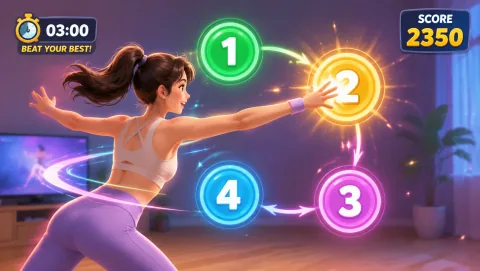
If the party already uses a large screen, a body-controlled game can be more social than passing a controller. MovePlay can run from a browser and works best in this setting as short, visible rounds rather than long solo play.
Run one practice round before keeping score. It is faster than explaining every edge case while people are waiting.
Team rhythm game
One person creates a clap-step pattern. The team copies it. Add one beat each round.
Human ranking line
Ask guests to line up by birthday month, distance traveled to the party, height, or another neutral category—without speaking. It adds movement and interaction without a winner.
What matters once people arrive:
The social rhythm matters as much as the rules. The strongest formats let people drift in and out without needing the event to stop and restart. When the group stays engaged between turns, the game has solved the harder social problem.
Keep participation optional:
A house party is not a workshop. Do not call everyone to attention for a 20-minute game unless the group clearly wants it.
Put a game into the evening, run one round, and see whether people ask for another. Good party games create their own demand.
One thing I would not ignore
For a household or gathering, I would judge the game by the whole room rather than the most competitive player. The strongest formats let people drift in and out without needing the event to stop and restart. When the group stays engaged between turns, the game has solved the harder social problem.
Do less, but make it work
Family play works best when it leaves room for different ages and different levels of enthusiasm. Short turns, team scores, and roles for observers keep more people involved without forcing identical participation. That flexibility is usually what makes a family game worth bringing back.
Keep the social pressure lower than the benefit
Best fit: this is useful when people can join for a short reset, understand the invitation immediately, and leave without having to explain why they are sitting out.
Limit: it is a poor choice when participation is treated as a performance, the activity competes with a serious meeting, or colleagues have very different comfort levels with cameras and movement.
If you are choosing: If you are choosing between ideas, prefer a short optional round with a personal target over a public leaderboard. The goal is an easier break, not another workplace metric.