Some days you have enough time to move but not enough interest in a full workout. That does not have to become a zero-activity day.
Use a short option that matches your energy.
The useful question is what you would still do on a busy or low-energy day. If an activity is enjoyable enough to repeat, it has an advantage over a theoretically optimal routine you keep avoiding. The aim is to make movement easier to return to.
Walk for ten minutes
Outside is ideal when convenient, but indoor walking, stairs, or pacing during a call also work.
Many adults need a smaller commitment, not a more sophisticated workout. If an activity is enjoyable enough to repeat, it has an advantage over a theoretically optimal routine you keep avoiding. The aim is to make movement easier to return to.
For adults, the hardest part is often starting rather than knowing what movement is available. Feedback such as skill, mood, score, or simply less sitting can be more motivating in the moment than an estimated calorie number. The aim is to make movement easier to return to.
Play one active game:
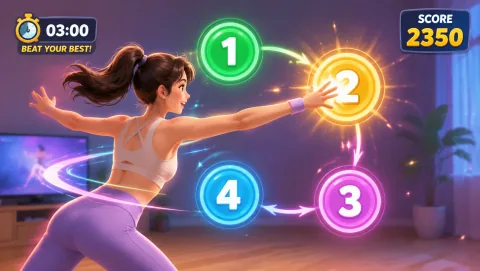
Choose a motion game with short rounds. A webcam game such as MovePlay can turn a few minutes of reaching, squatting, or swiping into a self-contained session.
Stop after a set number of rounds.
Put on three songs
Move through the first two and use the last as a slower finish. No choreography required.
A sustainable active routine usually has a very low-friction version. Feedback such as skill, mood, score, or simply less sitting can be more motivating in the moment than an estimated calorie number. The aim is to make movement easier to return to.
Do a mobility circuit
Use slow shoulder, torso, hip, and ankle movements. This is a useful low-energy option when cardio is not appealing.
It helps to judge movement by repeatability before ambition. Feedback such as skill, mood, score, or simply less sitting can be more motivating in the moment than an estimated calorie number. The aim is to make movement easier to return to.
Clean one zone quickly:
Set a ten-minute timer and move continuously through one room. It is not a complete exercise plan, but it does get you out of the chair.
Practice one skill:
Try balance, juggling, ball handling, jump rope, dance steps, or shadow boxing.
Take a movement snack between tasks:
Use two minutes of marching, reaching, and side stepping every hour or two rather than one longer block.
Drop the all-or-nothing rule
A short session does not need to “make up” for missing a longer workout. Physical-activity guidance recognizes that activity of any duration can contribute to total movement.
Use the small version because it is available today. A routine is more robust when it has options between “full workout” and “nothing.”
The useful question is what you would still do on a busy or low-energy day. Feedback such as skill, mood, score, or simply less sitting can be more motivating in the moment than an estimated calorie number. The aim is to make movement easier to return to.
Judge the format by the device and the room
Best fit: start here when the device is already available, the camera view is understandable, and the activity can be completed without moving furniture or sharing more video than necessary.
Limit: it is a weaker choice when the connection is unstable, the frame is crowded, the light makes tracking unreliable, or the player needs a movement the camera cannot read consistently.
If you are choosing: If you are choosing between a digital and an offline version, test the first cue before choosing the game. Use the offline option when it gives clearer feedback or a more comfortable way to participate.