Holiday games have to survive a room where people are talking, eating, arriving late, and leaving early. The strongest choices are simple enough for kids, interesting enough for adults, and flexible enough that nobody has to participate in every round.
Mixed-age groups expose weaknesses in a game very quickly. The strongest formats let people drift in and out without needing the event to stop and restart. A good format gives the room something to do together without demanding that everyone behave the same way.
Formats that work well for families
Holiday charades
Use seasonal films, songs, foods, traditions, and objects. Split into mixed-age teams so younger children can get help reading prompts.
Mixed-age groups usually work better when the same game can be played for a personal best as well as for a winner.
Family photo quiz
Holiday gatherings are a good time to use old photos. Ask who is pictured, where the photo was taken, or what happened that year.
If one person is hesitant, let them watch a round or take a scorekeeping role before asking them to perform.
Wrapped-object guessing
Place a few safe household objects inside bags or boxes and let players identify them by touch. This works well for mixed ages and does not reward speed.
A family game is easier to repeat when setup takes less time than explaining whose turn it is.
Active challenge station
Create a safe area for one short physical game: target toss, balance, pose matching, or a camera-controlled reaction game.
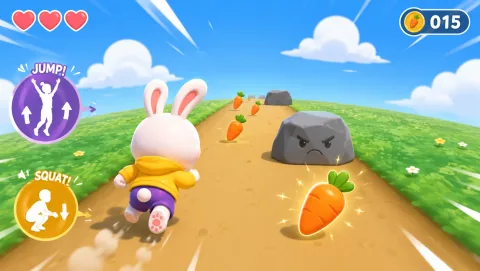
If you use MovePlay, short rounds are better than long sessions because people can rotate between the game and the rest of the gathering.
A family game is partly about the people who are not holding the controller. The strongest formats let people drift in and out without needing the event to stop and restart. A good format gives the room something to do together without demanding that everyone behave the same way.
Holiday music game
Play a few seconds of songs from different eras. Award points for title, performer, film, or decade.
Keep turns short enough that the people watching remain part of the moment instead of starting a separate conversation.
Minute-to-win-it style tasks
Keep them genuinely simple: stack cups, move cotton balls with a spoon, balance an object, or complete a quick pattern. Avoid messy tasks near food and crowded rooms.
Kids-versus-adults, carefully
A few rounds of kids versus adults can be funny, but do not make every activity depend on strength, height, or general knowledge. Mix the skills across the evening.
How to keep more people involved:
The social rhythm matters as much as the rules. The strongest formats let people drift in and out without needing the event to stop and restart. A good format gives the room something to do together without demanding that everyone behave the same way.
Make room for observers
Some relatives will prefer watching, judging, timing, or taking photos. Let that count as participation.
A holiday game succeeds when it creates shared moments without making the gathering feel scheduled. One good 15-minute game can be more memorable than a full evening of forced activities.
One thing I would not ignore
For a household or gathering, I would judge the game by the whole room rather than the most competitive player. The strongest formats let people drift in and out without needing the event to stop and restart. A good format gives the room something to do together without demanding that everyone behave the same way.
The real test of a family game
Family play works best when it leaves room for different ages and different levels of enthusiasm. Short turns, team scores, and roles for observers keep more people involved without forcing identical participation. When the group stays engaged between turns, the game has solved the harder social problem.
Keep the social pressure lower than the benefit
Best fit: this is useful when people can join for a short reset, understand the invitation immediately, and leave without having to explain why they are sitting out.
Limit: it is a poor choice when participation is treated as a performance, the activity competes with a serious meeting, or colleagues have very different comfort levels with cameras and movement.
If you are choosing: If you are choosing between ideas, prefer a short optional round with a personal target over a public leaderboard. The goal is an easier break, not another workplace metric.