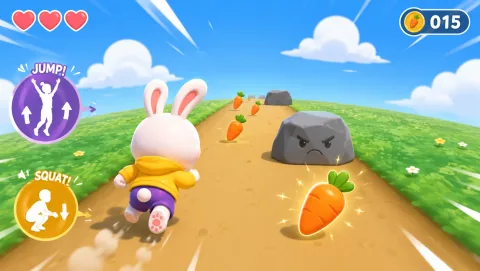
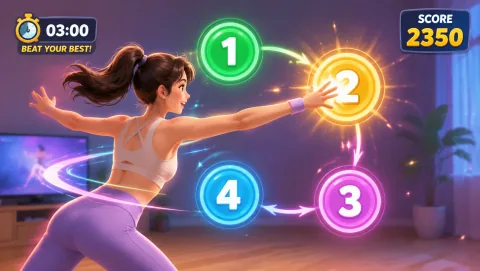
The most successful active games hide the repetition inside a goal. You squat because an obstacle is coming, reach because a target appears, or keep moving because the song has not ended.
A sustainable active routine usually has a very low-friction version. Feedback such as skill, mood, score, or simply less sitting can be more motivating in the moment than an estimated calorie number. A routine that survives ordinary days is the one with the best chance of lasting.
Low-friction ways to move
Dance games
The objective is rhythm and timing, not completing a set. Difficulty can range from beginner-friendly songs to demanding choreography.
It helps to judge movement by repeatability before ambition. Feedback such as skill, mood, score, or simply less sitting can be more motivating in the moment than an estimated calorie number. A routine that survives ordinary days is the one with the best chance of lasting.
VR rhythm games
Headsets can make movement immersive because targets appear around you in 3D space. Cost, headset comfort, and play-space requirements are the main trade-offs.
If the format is enjoyable, resist the urge to optimize it immediately into a complicated program.
Motion-console sports
Bowling, tennis, boxing, and other sports mini-games use motion-capable controllers. They work especially well for households that already own the console.
Use effort that feels appropriate today; tomorrow's repeat matters more than today's heroic session.
Webcam games
Camera-controlled games use body or hand movement without a handheld controller.
MovePlay is one browser-based example. Fruit Slash emphasizes arm swipes, Reaction uses reaching, SquatPacman uses lower-body movement, and BunnyHop is more full-body. Different titles create very different effort levels.
A score or streak can be motivating, but it should not make you ignore discomfort or poor movement quality.
Real-world skill games
Table tennis, badminton, juggling, frisbee, and casual ball games create movement because the player is solving a skill problem.
The useful question is what you would still do on a busy or low-energy day. Feedback such as skill, mood, score, or simply less sitting can be more motivating in the moment than an estimated calorie number. A routine that survives ordinary days is the one with the best chance of lasting.
Location-based games
Walking games, geocaching, photo hunts, and navigation challenges give you a reason to cover distance.
Attach it to a natural break in the day so you do not need a second decision about when to begin.
What makes a game feel different from exercise?
Usually it has at least one of these:
- score;
- opponent;
- music;
- skill progression;
- surprise;
- story;
- visible target;
- social interaction.
None of that guarantees a high-intensity workout. It changes motivation, not physiology.
If traditional exercise feels boring, active games can be a useful entry point because movement becomes the method rather than the entire purpose.
How to make it repeatable
Many adults need a smaller commitment, not a more sophisticated workout. Feedback such as skill, mood, score, or simply less sitting can be more motivating in the moment than an estimated calorie number. A routine that survives ordinary days is the one with the best chance of lasting.
One thing I would not ignore
For adults, the hardest part is often starting rather than knowing what movement is available. Leaving room for ten-minute days makes consistency easier and does not stop you from doing more when you have momentum. A routine that survives ordinary days is the one with the best chance of lasting.
Reduce the friction first
A sustainable active routine usually has a very low-friction version. Leaving room for ten-minute days makes consistency easier and does not stop you from doing more when you have momentum. A routine that survives ordinary days is the one with the best chance of lasting.
Judge the format by the device and the room
Best fit: start here when the device is already available, the camera view is understandable, and the activity can be completed without moving furniture or sharing more video than necessary.
Limit: it is a weaker choice when the connection is unstable, the frame is crowded, the light makes tracking unreliable, or the player needs a movement the camera cannot read consistently.
If you are choosing: If you are choosing between a digital and an offline version, test the first cue before choosing the game. Use the offline option when it gives clearer feedback or a more comfortable way to participate.