Good grandparent-grandchild games do not depend on both players having the same speed, mobility, or familiarity with technology. The strongest choices create conversation, cooperation, or light competition while allowing the rules to flex.
Mixed-age groups expose weaknesses in a game very quickly. Elimination and long turns can make half the group mentally leave before the game is over. A good format gives the room something to do together without demanding that everyone behave the same way.
Formats that work well for families
Family memory games
Look through photos and play “who, where, when?” Grandparents can tell the story after the child guesses.
You can also reverse the direction: the child shows a recent photo and asks the grandparent to guess the event.
Mixed-age groups usually work better when the same game can be played for a personal best as well as for a winner.
Drawing and guessing
Take turns drawing animals, objects, films, or family members. Younger children do not need to spell, and grandparents do not need fast reactions.
If one person is hesitant, let them watch a round or take a scorekeeping role before asking them to perform.
Gentle movement games
Use seated reaches, balloon taps, slow mirror movements, or simple pose matching.
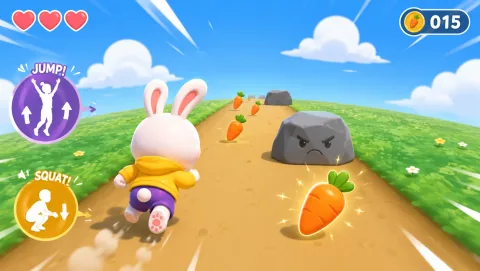
If using a motion game, choose a low-demand format and test the setup first. Some MovePlay games rely mainly on reaching or hand movement; others require squats or jumps and may not fit the older player. The goal is shared play, not making everyone use the same intensity.
A family game is easier to repeat when setup takes less time than explaining whose turn it is.
Music guessing
Alternate songs from the grandparent’s era and the child’s era. Give one point for artist, title, film, or decade.
A family game is partly about the people who are not holding the controller. Elimination and long turns can make half the group mentally leave before the game is over. A good format gives the room something to do together without demanding that everyone behave the same way.
Cooperative puzzles
Jigsaws, word games, and simple digital puzzles create a shared task without needing a winner.
Keep turns short enough that the people watching remain part of the moment instead of starting a separate conversation.
Let each generation teach one game
The child chooses a game they know. The grandparent chooses one from their childhood or family tradition. Both become teacher and learner at different points.
How to keep more people involved:
The social rhythm matters as much as the rules. Elimination and long turns can make half the group mentally leave before the game is over. A good format gives the room something to do together without demanding that everyone behave the same way.
Simple card and matching games:
Choose familiar rules and large, readable pieces when needed. Matching, dominoes, simple rummy-style games, and picture cards work well because the pace is adjustable.
Keep the session easy to stop
Ten to 20 minutes can be enough, especially if one participant tires sooner.
The value of intergenerational play is not that the activity is perfectly balanced. It is that the game gives two people with very different daily lives something concrete to do together.
One thing I would not ignore
For a household or gathering, I would judge the game by the whole room rather than the most competitive player. Elimination and long turns can make half the group mentally leave before the game is over. A good format gives the room something to do together without demanding that everyone behave the same way.
The real test of a family game
Family play works best when it leaves room for different ages and different levels of enthusiasm. A player can compete, someone else can keep score, and another person can watch first without the format falling apart. A good format gives the room something to do together without demanding that everyone behave the same way.
Make the activity work in the real timetable
Best fit: use this when the teacher can explain one visible rule, keep the first turn brief, and give students a clear way to watch, lead, or pause without being singled out.
Limit: it is a poor fit when setup takes longer than the learning goal, the room cannot be reset safely, or the scoring rewards speed over control. A lower-tech version may teach the same idea better.
If you are choosing: If you are choosing between formats, begin with the option that needs the fewest materials and the least movement across the room. Test one round before committing the whole class.