Not every motion game needs a standing player. For some people, sitting is more comfortable; for others, it simply makes sense for a short break or shared space.
The best seated games use the upper body deliberately rather than treating the chair as an afterthought.
Inclusive motion play is mostly a collection of practical design choices. Target height, reach distance, camera angle, reaction time, contrast, sound dependence, and role design can all create or remove barriers. Inclusive design is often less about adding modes than removing unnecessary obstacles.
Hand-reaction games
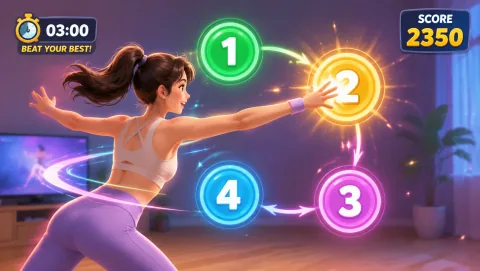
Pointing, tapping, swiping, and reaching toward screen targets can create quick, satisfying rounds from a chair.
The player's actual position is the right place to evaluate the experience. Target height, reach distance, camera angle, reaction time, contrast, sound dependence, and role design can all create or remove barriers. Inclusive design is often less about adding modes than removing unnecessary obstacles.
Difficulty can come from memory, choices, or timing instead of requiring a larger physical range.
The goal is meaningful participation, not identical movement. Target height, reach distance, camera angle, reaction time, contrast, sound dependence, and role design can all create or remove barriers. Inclusive design is often less about adding modes than removing unnecessary obstacles.
Upper-body pose games
Arm positions, shoulder movement, and simple directional poses work if the camera can see the player clearly.
Accessibility is strongest when alternatives exist before anyone has to ask for them. Difficulty can grow through memory, sequencing, precision, or choice rather than demanding larger and faster movements. Inclusive design is often less about adding modes than removing unnecessary obstacles.
A feature label does not tell you whether an activity is comfortable in the real room. Difficulty can grow through memory, sequencing, precision, or choice rather than demanding larger and faster movements. Inclusive design is often less about adding modes than removing unnecessary obstacles.
Rhythm and sequence games
Follow a repeated pattern with hands or arms. Challenge can come from timing rather than physical range.
Inclusive motion play is mostly a collection of practical design choices. Difficulty can grow through memory, sequencing, precision, or choice rather than demanding larger and faster movements. Inclusive design is often less about adding modes than removing unnecessary obstacles.
Accuracy games:
Large targets can gradually become smaller or appear in different positions without requiring standing.
Group turn-taking
A seated digital game works well as one station in a family, classroom, workplace, or senior-center session. Other participants can choose prompts or keep score.
Before starting, position the chair safely, move obstacles out of reach range, and test the camera from the actual seated height.
Choosing to sit does not need an explanation. A good motion game should make the participation option feel normal.
The player's actual position is the right place to evaluate the experience. Difficulty can grow through memory, sequencing, precision, or choice rather than demanding larger and faster movements. Inclusive design is often less about adding modes than removing unnecessary obstacles.
Make the activity work in the real timetable
Best fit: use this when the teacher can explain one visible rule, keep the first turn brief, and give students a clear way to watch, lead, or pause without being singled out.
Limit: it is a poor fit when setup takes longer than the learning goal, the room cannot be reset safely, or the scoring rewards speed over control. A lower-tech version may teach the same idea better.
If you are choosing: If you are choosing between formats, begin with the option that needs the fewest materials and the least movement across the room. Test one round before committing the whole class.