Mixed-age groups are difficult because “fair” does not mean giving everyone the exact same task. A six-year-old, a 35-year-old, and a 75-year-old may all enjoy the same game if the rules leave room for different strengths.
Mixed-age groups expose weaknesses in a game very quickly. Short turns, team scores, and roles for observers keep more people involved without forcing identical participation. A good format gives the room something to do together without demanding that everyone behave the same way.
Favor short turns
Long turns make mixed groups feel slower because less-involved players drift away. Thirty-second to two-minute rounds keep attention in the room.
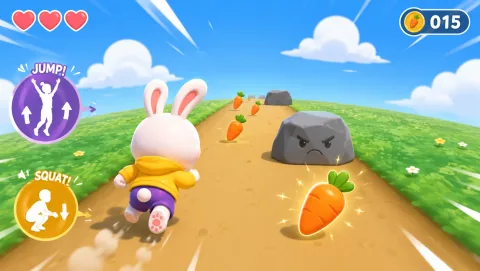
This is particularly useful for one-screen games. A MovePlay reaction or pose game can be run as a quick family event, with each player taking one attempt and the group watching.
Keep turns short enough that the people watching remain part of the moment instead of starting a separate conversation.
Add games that reward memory and stories
Physical skill should not dominate the event. Include:
- “who remembers?” family questions;
- photo identification;
- finish-the-story prompts;
- music from several generations.
Older relatives often become the experts in these rounds.
If one person is hesitant, let them watch a round or take a scorekeeping role before asking them to perform.
How to keep more people involved
A family game is partly about the people who are not holding the controller. Short turns, team scores, and roles for observers keep more people involved without forcing identical participation. A good format gives the room something to do together without demanding that everyone behave the same way.
Use team formats
Mix ages rather than creating age-versus-age competition.
Good team games include:
- family trivia;
- scavenger hunts;
- drawing and guessing;
- relay-style puzzle solving;
- combined-score movement challenges.
Teams make it possible for one person to contribute speed while another contributes knowledge or strategy.
The social rhythm matters as much as the rules. Short turns, team scores, and roles for observers keep more people involved without forcing identical participation. A good format gives the room something to do together without demanding that everyone behave the same way.
Choose games with adjustable difficulty:
A target game can use different distances. A reaction game can use score handicaps. A movement game can allow standing, seated, or caller roles.
The shared rule stays the same while the physical demand changes.
Avoid elimination:
The first people eliminated are often children, older adults, or less-experienced players—the exact people you are trying to keep involved.
Use points, teams, or repeatable rounds instead.
Make participation optional:
Not everyone wants to stand in front of the group. Offer scorekeeper, judge, caller, clue-reader, or spectator roles.
A successful mixed-age game does not make every person do the same thing. It gives everyone a legitimate way to take part.
One thing I would not ignore
For a household or gathering, I would judge the game by the whole room rather than the most competitive player. Short turns, team scores, and roles for observers keep more people involved without forcing identical participation. A good format gives the room something to do together without demanding that everyone behave the same way.
Keep the whole room in mind
Family play works best when it leaves room for different ages and different levels of enthusiasm. Elimination and long turns can make half the group mentally leave before the game is over. A good format gives the room something to do together without demanding that everyone behave the same way.
Keep the social pressure lower than the benefit
Best fit: this is useful when people can join for a short reset, understand the invitation immediately, and leave without having to explain why they are sitting out.
Limit: it is a poor choice when participation is treated as a performance, the activity competes with a serious meeting, or colleagues have very different comfort levels with cameras and movement.
If you are choosing: If you are choosing between ideas, prefer a short optional round with a personal target over a public leaderboard. The goal is an easier break, not another workplace metric.