Getting kids moving at home does not require a home gym. It requires an activity with a reason to move: chase a score, copy a pattern, reach a target, keep something in the air, or finish a challenge.
Here are options that work with ordinary household space.
The practical test is what happens after the first burst of excitement. Short rules, a visible finish, and movement that fits the furniture make repeat use much more likely. The goal is a reliable option the family can actually reuse.
Add movement to familiar games
Take something the child already likes and attach a physical rule.
- Answer a trivia question, then do a balance pose.
- Roll a die; each number maps to a movement.
- Spell a word, doing one action per letter.
- Play memory, but place cards at opposite ends of a safe area.
The game does not need to be marketed as fitness to create movement.
Keep the first round short. If the child immediately asks to do it again, repeat before adding more rules.
Create family challenges
Movement is easier to repeat when adults participate sometimes.
Try:
- parent vs child reaction score;
- 60-second balloon challenge;
- family pose contest;
- balance tournament;
- “three games, three skills” night.
Keep the competition light enough that younger or less athletic family members still want another turn.
With children, the room and the timing matter as much as the idea itself. Short rules, a visible finish, and movement that fits the furniture make repeat use much more likely. The goal is a reliable option the family can actually reuse.
How I would choose
A parent usually needs something that works under ordinary conditions, not a perfect activity day. Short rules, a visible finish, and movement that fits the furniture make repeat use much more likely. The goal is a reliable option the family can actually reuse.
Turn the room into a game board
Use safe landmarks rather than elaborate equipment.
- Touch the sofa, then the door, then return to the start.
- Step between three floor zones in a called order.
- Follow a tape line if one is already available, or use grout lines and rug edges as boundaries.
- Choose “safe islands” and move between them without touching other areas.
In a small home, stepping and reaching are usually better than running.
Use music
Dance is one of the easiest ways to change the energy of a room.
Try freeze dance, copy-the-leader, one-song challenges, or rhythm imitation. For children who dislike free dancing, give them specific moves to copy instead.
In a real home, the deciding factor is often not how creative an activity sounds but how quickly a child can understand it. If the child needs constant correction or adult help, the activity is less independent than it looked on the list. The goal is a reliable option the family can actually reuse.
Use motion-controlled games
Camera games can work when the child already wants screen time. Instead of replacing the screen, the game changes what the child does in front of it.
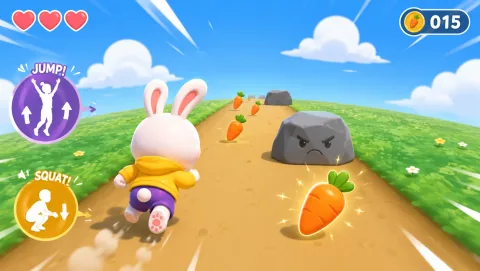
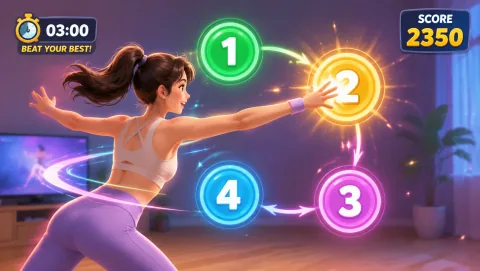
MovePlay has games built around different actions: Fruit Slash uses arm swipes, Reaction uses target reaching, SquatPacman uses squatting, and BunnyHop uses larger full-body movement. Pick the control style before picking the theme.
Use short sessions throughout the day
Movement does not have to arrive as one formal block. A five-minute game before homework, a dance break after lunch, and a family round in the evening can all contribute to a more active day.
WHO guidance emphasizes that all physical activity counts and that some activity is better than none. For families, that is a useful practical principle: do not wait for the perfect hour-long session before making room for movement.
One thing I would not ignore:
For family use, I would put ease of starting ahead of novelty. If the child needs constant correction or adult help, the activity is less independent than it looked on the list. The goal is a reliable option the family can actually reuse.
A simple way to judge the game:
The aim is not to manufacture exhaustion. Give the energy a job, then make the next transition easier.
Choose it for the group in front of you
Best fit: this works when the ages and confidence levels can share one simple goal, with an adult able to explain the first round and step in if the room loses focus.
Limit: it is a weaker choice when children are tired, the ages are far apart, or one person is expected to perform in front of everyone. A quieter role or a shorter round may be the better answer.
If you are choosing: start with the smallest version that can succeed in the available space. Add speed, scoring, or competition only after the group understands the basic action.