Games for older adults should not be chosen only because they are “good for seniors.” The better starting point is interest: conversation, music, memory, light competition, movement, cards, puzzles, or family play.
Activities for older adults should begin with the person, not the age label. Large cues, generous timing, short rounds, and seated or standing options reduce unnecessary barriers without removing humor or challenge. That flexibility is what makes a format usable across very different days and participants.
Familiar card and tile games
Bridge, rummy, dominoes, mahjong, chess, and simple matching games can be easier to return to because the rules are already known.
Simple rules do not require childish presentation. Large cues, generous timing, short rounds, and seated or standing options reduce unnecessary barriers without removing humor or challenge. That flexibility is what makes a format usable across very different days and participants.
Short rounds make rest easier and reduce the social pressure to continue when someone is tired.
Music games
Try name-that-song, finish-the-lyric, decade quizzes, or building a shared playlist. Music can create conversation even when nobody wants a formal game.
Mixed ability is normal in older-adult groups, not an edge case. Large cues, generous timing, short rounds, and seated or standing options reduce unnecessary barriers without removing humor or challenge. That flexibility is what makes a format usable across very different days and participants.
Photo and memory prompts
Use family photos, travel pictures, or old household objects as conversation starters. Ask where, when, or what happened—not as a memory test, but as a way to tell stories.
A good activity can stay challenging while becoming easier to access physically. Large cues, generous timing, short rounds, and seated or standing options reduce unnecessary barriers without removing humor or challenge. That flexibility is what makes a format usable across very different days and participants.
Gentle movement games
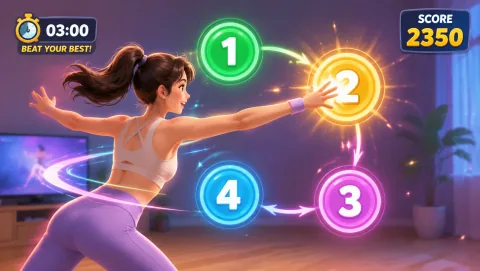
Balloon taps, seated reaches, mirror movement, target touching, and simple reaction games can add physical participation without requiring fast footwork.
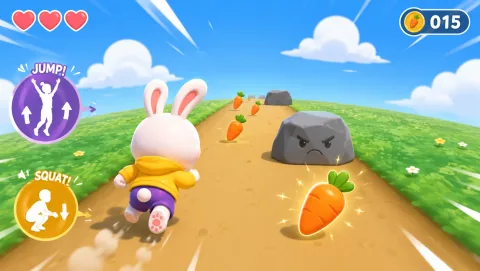
A webcam game may also work if the controls are large and simple. On MovePlay, hand- or reach-based games are more suitable than jump-heavy titles for many older players. The game should be adapted to the person, not the other way around.
Puzzles and word games:
Crosswords, word searches, jigsaws, trivia, and number puzzles are easy to scale by difficulty and can be done alone or together.
Play with another generation:
Grandchildren can teach a digital game; grandparents can teach a card or traditional game. The exchange itself is often more valuable than the specific game.
Keep the setup respectful
Avoid assuming that an older adult needs childish graphics or simplified conversation. Make text readable, rules clear, and pacing flexible without talking down to the player.
Games can support enjoyment, social interaction, and activity. They should not be presented as treatment for cognitive decline or other medical conditions unless a specific intervention has been clinically evaluated for that purpose.
The useful design question is how much choice the participant has. Large cues, generous timing, short rounds, and seated or standing options reduce unnecessary barriers without removing humor or challenge. That flexibility is what makes a format usable across very different days and participants.
Choose it for the group in front of you
Best fit: this works when the ages and confidence levels can share one simple goal, with an adult able to explain the first round and step in if the room loses focus.
Limit: it is a weaker choice when children are tired, the ages are far apart, or one person is expected to perform in front of everyone. A quieter role or a shorter round may be the better answer.
If you are choosing: start with the smallest version that can succeed in the available space. Add speed, scoring, or competition only after the group understands the basic action.