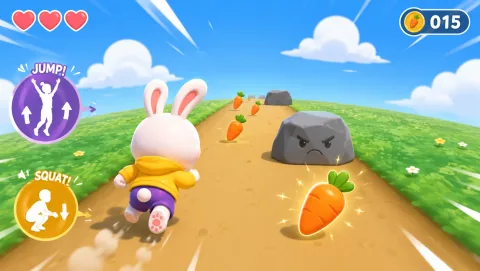
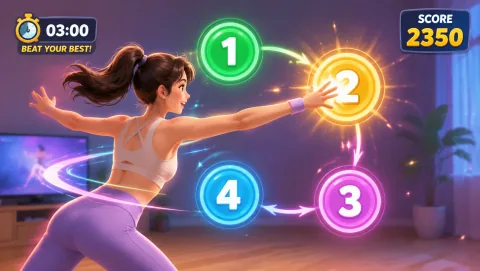
Full-body motion games combine several movement types—reaching, squatting, stepping, leaning, jumping, or posing—so the player uses the body as a broad control surface.
Good motion design filters out movement that does not matter to the game. Players need to know whether they missed the target or the system missed the movement, otherwise every failure feels like bad tracking. A mechanic is strongest when it remains clear even for a first-time player.
What you need
Enough distance for the camera to see the required body landmarks, enough floor and arm clearance for the movement, and a display visible from the play position.
Physical difficulty and game difficulty do not have to be the same thing. Players need to know whether they missed the target or the system missed the movement, otherwise every failure feels like bad tracking. A mechanic is strongest when it remains clear even for a first-time player.
Readable feedback is part of the control scheme, not decoration. Players need to know whether they missed the target or the system missed the movement, otherwise every failure feels like bad tracking. A mechanic is strongest when it remains clear even for a first-time player.
A strong motion mechanic makes the connection between body and screen obvious. Re-centering moments and short rounds help people recover from drift, missed inputs, and awkward starting positions. A mechanic is strongest when it remains clear even for a first-time player.
Why they feel different from controller games
The movement is not an extra layer on top of play; it is the input itself. Dodging, reaching, or squatting directly changes what happens in the game.
The player should not have to think constantly about how the tracking system works. Re-centering moments and short rounds help people recover from drift, missed inputs, and awkward starting positions. A mechanic is strongest when it remains clear even for a first-time player.
Good full-body design avoids constant intensity
Mix fast and slow actions. A game that demands maximal movement every second becomes tiring and often less fun.
Good motion design filters out movement that does not matter to the game. Re-centering moments and short rounds help people recover from drift, missed inputs, and awkward starting positions. A mechanic is strongest when it remains clear even for a first-time player.
Physical difficulty and game difficulty do not have to be the same thing. Re-centering moments and short rounds help people recover from drift, missed inputs, and awkward starting positions. A mechanic is strongest when it remains clear even for a first-time player.
Group play benefits from short rounds:
One person can play while others watch, then rotate. This works well for family gatherings, parties, classrooms, and events.
Tracking limits matter
Standard webcams can lose limbs when they overlap or leave the frame. Clear, exaggerated-but-comfortable movements are easier to track than subtle complex actions.
Full-body games are best when you actually have the space. In a cramped room, an excellent hand-tracking game is better than forcing a “full-body” experience into unsafe conditions.
Readable feedback is part of the control scheme, not decoration. Re-centering moments and short rounds help people recover from drift, missed inputs, and awkward starting positions. A mechanic is strongest when it remains clear even for a first-time player.
Make the activity work in the real timetable
Best fit: use this when the teacher can explain one visible rule, keep the first turn brief, and give students a clear way to watch, lead, or pause without being singled out.
Limit: it is a poor fit when setup takes longer than the learning goal, the room cannot be reset safely, or the scoring rewards speed over control. A lower-tech version may teach the same idea better.
If you are choosing: If you are choosing between formats, begin with the option that needs the fewest materials and the least movement across the room. Test one round before committing the whole class.