Board games are excellent, but they are not the only way to create shared play. If your family wants something faster, more physical, less rule-heavy, or easier for mixed ages, there are plenty of alternatives.
Family play works best when it leaves room for different ages and different levels of enthusiasm. Short turns, team scores, and roles for observers keep more people involved without forcing identical participation. The memorable part is often the shared reaction, not the complexity of the rules.
Formats that work well for families
Charades and guessing games
No board, no setup, and easy to adapt. Use films, animals, jobs, songs, or family members.
For younger children, let them choose from picture prompts instead of written cards.
Mixed-age groups usually work better when the same game can be played for a personal best as well as for a winner.
Movement challenges
Try balance, pose matching, slow-motion races, target reaching, or simple follow-the-leader games.
They work especially well when children have already spent much of the day sitting.
If one person is hesitant, let them watch a round or take a scorekeeping role before asking them to perform.
One-screen party games
A TV or laptop can turn into a shared game station rather than an individual screen.
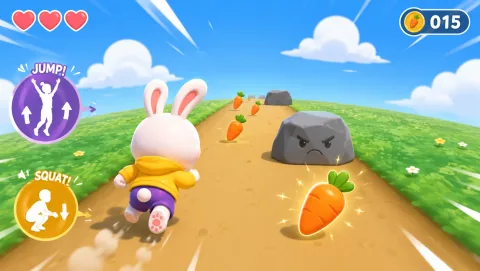
Options include trivia, drawing-and-guessing games, karaoke, rhythm games, and webcam motion games. With MovePlay, players can rotate through short reaction, pose, or full-body rounds while the rest of the family watches.
A family game is easier to repeat when setup takes less time than explaining whose turn it is.
Build-and-test games
Use paper, blocks, cardboard, or household items to create challenges:
- tallest tower;
- longest paper-airplane flight;
- strongest bridge;
- best marble route;
- fastest puzzle build.
The family can compete or work together.
Mixed-age groups expose weaknesses in a game very quickly. Short turns, team scores, and roles for observers keep more people involved without forcing identical participation. The memorable part is often the shared reaction, not the complexity of the rules.
Story games
Start a story and add one sentence per person. Add constraints: every sentence must include a chosen word, or the story must switch genres halfway through.
Keep turns short enough that the people watching remain part of the moment instead of starting a separate conversation.
Scavenger games
Create a list based on colors, textures, letters, or household categories. For family teams, mix younger and older players.
Mini tournaments
Combine three short games into one evening. This gives everyone a better chance of finding something they enjoy.
For example:
- reaction challenge;
- drawing round;
- family trivia.
Board games are great when the group wants to sit down and invest in one rule set. These alternatives work when the family wants movement, variety, or a quicker start.
How to keep more people involved
A family game is partly about the people who are not holding the controller. Short turns, team scores, and roles for observers keep more people involved without forcing identical participation. The memorable part is often the shared reaction, not the complexity of the rules.
One thing I would not ignore:
The social rhythm matters as much as the rules. Short turns, team scores, and roles for observers keep more people involved without forcing identical participation. The memorable part is often the shared reaction, not the complexity of the rules.
The real test of a family game
For a household or gathering, I would judge the game by the whole room rather than the most competitive player. Short turns, team scores, and roles for observers keep more people involved without forcing identical participation. The memorable part is often the shared reaction, not the complexity of the rules.
Keep the social pressure lower than the benefit
Best fit: this is useful when people can join for a short reset, understand the invitation immediately, and leave without having to explain why they are sitting out.
Limit: it is a poor choice when participation is treated as a performance, the activity competes with a serious meeting, or colleagues have very different comfort levels with cameras and movement.
If you are choosing: If you are choosing between ideas, prefer a short optional round with a personal target over a public leaderboard. The goal is an easier break, not another workplace metric.