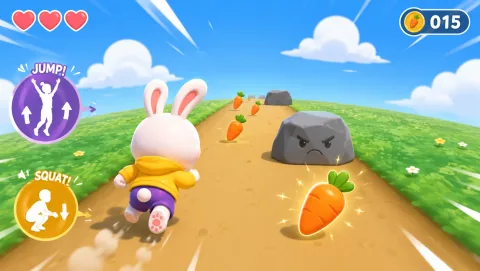
The hardest family games are not the most complicated ones. They are the ones that work when the room contains a six-year-old, a teenager, two adults, and someone who would rather watch than compete.
For mixed-age play, simple rules and flexible roles matter more than sophistication.
Family play works best when it leaves room for different ages and different levels of enthusiasm. Short turns, team scores, and roles for observers keep more people involved without forcing identical participation. That flexibility is usually what makes a family game worth bringing back.
How to keep more people involved
Mixed-age groups expose weaknesses in a game very quickly. Short turns, team scores, and roles for observers keep more people involved without forcing identical participation. That flexibility is usually what makes a family game worth bringing back.
Choose games that are easy to join
A good family game should take less than a minute to explain. That usually favors:
- reaction challenges;
- drawing or guessing games;
- simple team trivia;
- balloon games;
- charades;
- movement or pose games;
- short score-based challenges.
Games with long setup, detailed strategy, or player elimination tend to lose part of the room early.
Make watching part of the game
In a family gathering, not everyone needs to play at the same time. A game can still work if the people waiting are entertained, commenting, keeping score, or choosing the next challenge.
This is one reason motion games can fit family play. In MovePlay, a person can play a short round of Whack A Mole, Reaction, or a pose game while the rest of the room watches and rotates in. The visible body movement gives spectators something to react to.
Use teams when ages are very different
Instead of child versus grandparent, mix the ages.
Try:
- adult + child teams;
- alternating rounds with combined scores;
- one player performs while a teammate calls instructions;
- family trivia followed by a physical challenge;
- best-of-three games where each round tests a different skill.
This makes the evening less dependent on one type of ability.
A family game is partly about the people who are not holding the controller. Short turns, team scores, and roles for observers keep more people involved without forcing identical participation. That flexibility is usually what makes a family game worth bringing back.
Keep a low-movement option:
Not everyone can or wants to jump, squat, or move quickly. Include at least one seated, verbal, drawing, or hand-focused game.
Participation should not require performing physically in front of the whole room.
Good family games end cleanly
Choose short rounds. A game night is easier to manage when people can play for 20 minutes, stop for dessert, then start something else later.
The best family game is rarely the one with the deepest rules. It is the one that gets a surprisingly large part of the room saying, “I’ll have a turn.”
One thing I would not ignore:
The social rhythm matters as much as the rules. Short turns, team scores, and roles for observers keep more people involved without forcing identical participation. That flexibility is usually what makes a family game worth bringing back.
What makes the format last
For a household or gathering, I would judge the game by the whole room rather than the most competitive player. Short turns, team scores, and roles for observers keep more people involved without forcing identical participation. That flexibility is usually what makes a family game worth bringing back.
Keep the social pressure lower than the benefit
Best fit: this is useful when people can join for a short reset, understand the invitation immediately, and leave without having to explain why they are sitting out.
Limit: it is a poor choice when participation is treated as a performance, the activity competes with a serious meeting, or colleagues have very different comfort levels with cameras and movement.
If you are choosing: If you are choosing between ideas, prefer a short optional round with a personal target over a public leaderboard. The goal is an easier break, not another workplace metric.