Family game night does not have to mean everyone sitting around a table. If your family has mixed energy levels—or children who struggle to stay seated through a long board game—add one or two activities that make people stand up and move.
You do not need to make the whole evening a workout.
Family play works best when it leaves room for different ages and different levels of enthusiasm. Elimination and long turns can make half the group mentally leave before the game is over. That flexibility is usually what makes a family game worth bringing back.
Run a three-event family challenge
Pick three games that reward different skills:
- Accuracy: sock toss into a basket.
- Reaction: a target game or webcam reaction round.
- Control: balance or pose challenge.
Give points for each event or simply name a winner for each category. Different family members get a chance to be good at something.
Keep turns short enough that the people watching remain part of the moment instead of starting a separate conversation.
Try family charades with movement
Use animals, sports, movie characters, or family memories. For younger kids, keep the categories visual and familiar.
A “statue round” works well too: one person creates a pose, everyone else copies it, and the group votes on the closest match.
If one person is hesitant, let them watch a round or take a scorekeeping role before asking them to perform.
Add a cooperative round
Not every event needs a winner.
Try:
- keep a balloon up for 100 taps as a family;
- build a 15-move memory sequence;
- complete a scavenger hunt together;
- combine everyone’s scores to reach a target;
- create a group dance or movement routine.
Mixed-age groups expose weaknesses in a game very quickly. Elimination and long turns can make half the group mentally leave before the game is over. That flexibility is usually what makes a family game worth bringing back.
How to keep more people involved:
A family game is partly about the people who are not holding the controller. Elimination and long turns can make half the group mentally leave before the game is over. That flexibility is usually what makes a family game worth bringing back.
Use one screen as a shared game station
Instead of everyone playing on separate phones, use one TV or laptop and rotate turns.
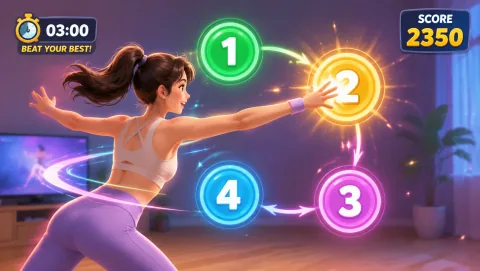
A browser motion game can work well because the player is visible to the rest of the room. With MovePlay, short games such as Reaction, Whack A Mole, or AwkwardPose can become individual events in a family tournament. Connect a laptop to a larger display if the room setup allows it.
Keep the evening flexible
A useful format is 10–15 minutes of active play, then another activity, then a final challenge later. That works better for mixed ages than asking everyone to stay in one game for an hour.
If grandparents or less-mobile family members are involved, choose hand-led, seated, or caller roles so the activity remains inclusive.
Active family game night works best when movement adds variety. It should make the evening easier to share, not turn family time into a compulsory fitness session.
One thing I would not ignore:
The social rhythm matters as much as the rules. Elimination and long turns can make half the group mentally leave before the game is over. That flexibility is usually what makes a family game worth bringing back.
Keep the whole room in mind
For a household or gathering, I would judge the game by the whole room rather than the most competitive player. Elimination and long turns can make half the group mentally leave before the game is over. That flexibility is usually what makes a family game worth bringing back.
Choose it for the group in front of you
Best fit: this works when the ages and confidence levels can share one simple goal, with an adult able to explain the first round and step in if the room loses focus.
Limit: it is a weaker choice when children are tired, the ages are far apart, or one person is expected to perform in front of everyone. A quieter role or a shorter round may be the better answer.
If you are choosing: start with the smallest version that can succeed in the available space. Add speed, scoring, or competition only after the group understands the basic action.