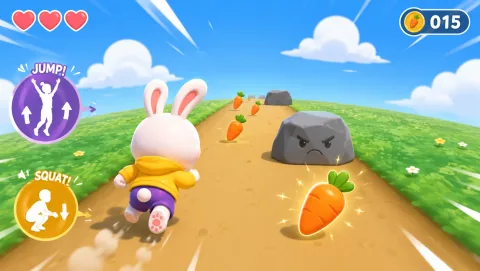
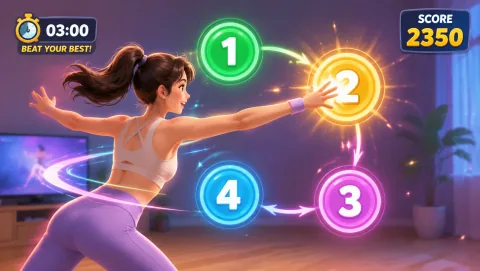
You do not need a console to make a computer part of an active session. A laptop or PC can support webcam motion games, rhythm tools, browser challenges, and other interactive formats that ask you to move instead of only press keys.
Active gaming works best for gamers when it still feels like a game first. Scores, mastery, short rounds, and recognizable mechanics matter more than dressing a workout in game graphics.
Webcam motion games
These use the built-in or external camera to detect reaches, squats, poses, swipes, or full-body movement.
They are easiest to try because the computer can be both the screen and the sensor.
Hardware matters less when the core loop is compelling. Start with what you already own before buying a new ecosystem.
Hardware changes the social feel of active gaming as much as the tracking accuracy. Clear goals, score, timing, progression, and room for skill improvement make movement feel like input rather than homework. That is a stronger motivation loop than telling a gamer they ought to move more.
For a gamer, mastery and feedback usually matter more than wellness language. Clear goals, score, timing, progression, and room for skill improvement make movement feel like input rather than homework. That is a stronger motivation loop than telling a gamer they ought to move more.
Browser reaction games:
Large targets, hand tracking, and short score rounds work well for five- or ten-minute breaks. They usually need less space than full-body games.
Short arcade-style rounds work well because players can chase improvement without committing to a long session.
Dance and rhythm
Some PC and web experiences use camera tracking; others use keyboard, phone, or video-based participation. Choose based on whether you want the software to respond to your movement or simply guide it.
Gamers already understand the pull of mastery. The active version works when movement supports that same loop: read the situation, make a decision, execute, see the result, try again. If the movement is only an arbitrary fitness tax between interesting parts of the game, experienced players will notice immediately.
Fitness games and training apps:
Structured desktop or web programs may provide workouts, timers, and tracking rather than game mechanics. They are a better choice if coaching and progression matter more than play.
Emulation and old motion hardware:
Legacy Kinect and similar setups can still be interesting technical projects, but they require drivers, compatible hardware, and more setup than an ordinary webcam game.
Make the laptop setup safe
Keep the computer outside arm and leg range. If the screen is too small, connect it to a TV while leaving the camera in a position that can see the player.
Laptop active gaming is strongest when you want low additional hardware and short access time—not when you need the precision or immersion of a dedicated tracking system.
Do not force active gaming to replace your normal games. It can simply become one more genre in the rotation—especially on days when you want a break from sitting without turning the evening into a workout plan.
Judge the format by the device and the room
Best fit: start here when the device is already available, the camera view is understandable, and the activity can be completed without moving furniture or sharing more video than necessary.
Limit: it is a weaker choice when the connection is unstable, the frame is crowded, the light makes tracking unreliable, or the player needs a movement the camera cannot read consistently.
If you are choosing: If you are choosing between a digital and an offline version, test the first cue before choosing the game. Use the offline option when it gives clearer feedback or a more comfortable way to participate.