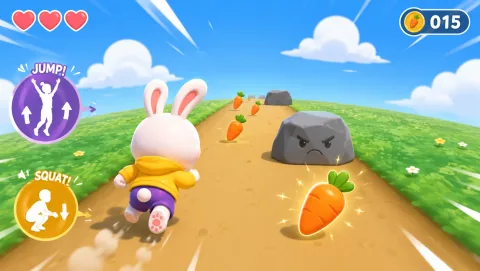
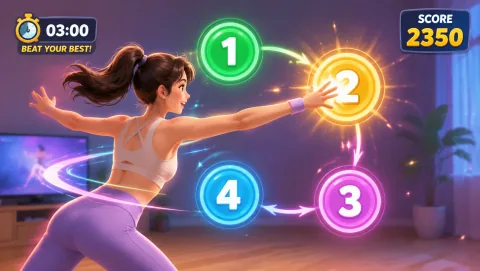
A child can dislike “exercise” and still love movement. Often the problem is the format: repetitive drills, adult-selected workouts, or activities that make the child feel behind everyone else.
Games change the question from “How many reps?” to “Can I hit the target, beat the score, or finish the challenge?”
A parent usually needs something that works under ordinary conditions, not a perfect activity day. Watch whether the child asks for another round without prompting; that is better evidence than how impressive the idea looks. That is the difference between an idea worth saving and one that only works once.
Do not promise more than the game provides
Active games can add movement to a child’s day, but they do not replace outdoor play, sports, PE, sleep, or a varied routine. They are one more way to make movement accessible—especially on days when weather, space, or motivation limits the other options.
Keep the first round short. If the child immediately asks to do it again, repeat before adding more rules.
How I would choose
In a real home, the deciding factor is often not how creative an activity sounds but how quickly a child can understand it. Short rules, a visible finish, and movement that fits the furniture make repeat use much more likely. The goal is a reliable option the family can actually reuse.
Start with play, not fitness language
If the child already resists exercise, calling a game a workout can make it harder to start. Lead with the activity itself.
Good options include:
- balloon volleyball;
- dance games;
- scavenger races;
- target throwing;
- obstacle missions;
- reaction games;
- motion-controlled video games;
- active family challenges.
The movement is still real even when the child is focused on the game rather than the exercise value.
Choose games with quick success
A child who does not enjoy sport may be especially sensitive to activities where skill gaps are obvious.
Look for:
- simple first-round rules;
- short attempts;
- personal scores rather than constant comparison;
- multiple ways to improve;
- no elimination;
- adjustable intensity.
MovePlay’s Whack A Mole and Fruit Slash, for example, are easy to understand because the goal is visible immediately. A child can improve by reacting faster without needing to learn a sport technique first.
Let the child choose the style of movement
Some kids dislike running but enjoy dancing. Others like striking, jumping, balancing, or fast hand reactions.
Offer two or three categories rather than one “exercise”:
- fast reactions: targets, whack-a-mole, catch games;
- big body movement: squat, dodge, jump, side step;
- rhythm: dance, stomp, follow-the-beat;
- precision: balance, pose matching, slow control.
Preference matters because the activity only helps if the child is willing to repeat it.
Keep sessions shorter than you think:
For a reluctant child, ten enjoyable minutes are more useful than a 30-minute session that turns into an argument. End while the game is still going well.
You can build a routine later. First establish that moving does not always feel like a chore.
One thing I would not ignore:
For family use, I would put ease of starting ahead of novelty. Short rules, a visible finish, and movement that fits the furniture make repeat use much more likely. The goal is a reliable option the family can actually reuse.
What I would keep:
The aim is not to manufacture exhaustion. Give the energy a job, then make the next transition easier.
Make the activity work in the real timetable
Best fit: use this when the teacher can explain one visible rule, keep the first turn brief, and give students a clear way to watch, lead, or pause without being singled out.
Limit: it is a poor fit when setup takes longer than the learning goal, the room cannot be reset safely, or the scoring rewards speed over control. A lower-tech version may teach the same idea better.
If you are choosing: If you are choosing between formats, begin with the option that needs the fewest materials and the least movement across the room. Test one round before committing the whole class.