Large targets and simple rules are useful for many players—not only older adults. They help beginners, children, people using a small screen, and anyone who wants to start without a tutorial.
Mixed ability is normal in older-adult groups, not an edge case. Music, accuracy, memory, teamwork, and prediction can create plenty of game value without relying on fast footwork. The most meaningful signal is often whether people want another round.
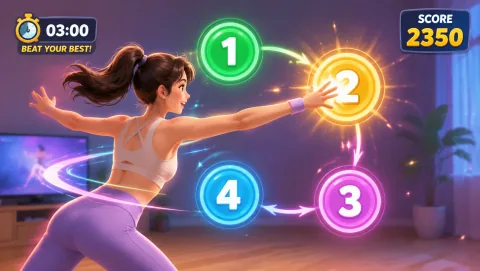
Whack-a-target games
A target appears; the player hits, taps, or reaches toward it. The cause-and-effect relationship is immediate.
A good activity can stay challenging while becoming easier to access physically. Music, accuracy, memory, teamwork, and prediction can create plenty of game value without relying on fast footwork. The most meaningful signal is often whether people want another round.
The useful design question is how much choice the participant has. Music, accuracy, memory, teamwork, and prediction can create plenty of game value without relying on fast footwork. The most meaningful signal is often whether people want another round.
Color matching
Show two or more large colors and ask the player to match, point, or select the correct one.
Short rounds make rest easier and reduce the social pressure to continue when someone is tired.
Activities for older adults should begin with the person, not the age label. People should be able to watch first, slow down, change roles, or skip a round without being singled out. The most meaningful signal is often whether people want another round.
One-direction reaction:
Use only left and right at first. Add high and low after the player understands the game.
Balloon or soft-ball target
In non-digital play, a large basket or wall zone creates a clear goal with adjustable distance.
Simple rules do not require childish presentation. People should be able to watch first, slow down, change roles, or skip a round without being singled out. The most meaningful signal is often whether people want another round.
Pose matching:
Show one large silhouette and ask the player to create the same general shape. Avoid requiring precise flexibility.
Simple digital motion games:
Camera games can work well if the visual target is obvious and tracking responds to broad movement. MovePlay’s Whack A Mole is an example of a mechanic that is easier to understand than a game requiring several simultaneous gestures.
Design choices that help
Look for:
- high contrast;
- large readable text;
- one main goal per screen;
- slow or adjustable pace;
- clear success feedback;
- no penalty for taking time to learn.
Simple is not childish
A game can be visually clean and cognitively interesting without cartoonish presentation or patronizing instructions.
For mixed-age families and older adults, simplicity is often what makes a game social: another person can understand what is happening from across the room and join the next round.
Mixed ability is normal in older-adult groups, not an edge case. People should be able to watch first, slow down, change roles, or skip a round without being singled out. The most meaningful signal is often whether people want another round.
Keep the social pressure lower than the benefit
Best fit: this is useful when people can join for a short reset, understand the invitation immediately, and leave without having to explain why they are sitting out.
Limit: it is a poor choice when participation is treated as a performance, the activity competes with a serious meeting, or colleagues have very different comfort levels with cameras and movement.
If you are choosing: If you are choosing between ideas, prefer a short optional round with a personal target over a public leaderboard. The goal is an easier break, not another workplace metric.