Playing with an older parent works best when the game is easy to understand, easy to pause, and not built around speed alone. The goal is not to find a “senior game.” It is to choose something both of you would actually enjoy doing together.
The useful design question is how much choice the participant has. Large cues, generous timing, short rounds, and seated or standing options reduce unnecessary barriers without removing humor or challenge. Respect and choice matter more than attaching a 'senior' label to the game.
Start with familiar games
Cards, dominoes, simple word games, checkers, and jigsaws work well because the rules are already known. Familiarity reduces the amount of explaining and lets the conversation stay part of the activity.
Activities for older adults should begin with the person, not the age label. Music, accuracy, memory, teamwork, and prediction can create plenty of game value without relying on fast footwork. Respect and choice matter more than attaching a 'senior' label to the game.
Short rounds make rest easier and reduce the social pressure to continue when someone is tired.
Simple rules do not require childish presentation. Music, accuracy, memory, teamwork, and prediction can create plenty of game value without relying on fast footwork. Respect and choice matter more than attaching a 'senior' label to the game.
Try cooperative games
If competition creates pressure, choose a shared target: finish a puzzle, beat a timer together, complete a sequence, or work through a trivia category as a team.
Mixed ability is normal in older-adult groups, not an edge case. Music, accuracy, memory, teamwork, and prediction can create plenty of game value without relying on fast footwork. Respect and choice matter more than attaching a 'senior' label to the game.
Use movement only when it fits
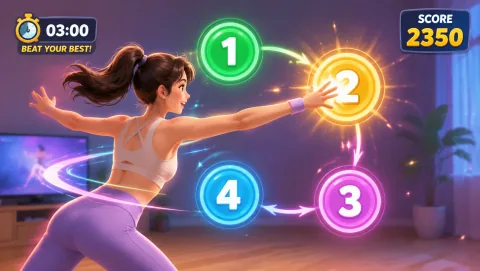
Balloon tap, target reaching, gentle follow-the-leader, and seated motion games can add movement without turning the session into a workout. For camera-based games, choose large targets, forgiving timing, and simple actions before trying anything fast or physically demanding.
A good activity can stay challenging while becoming easier to access physically. Music, accuracy, memory, teamwork, and prediction can create plenty of game value without relying on fast footwork. Respect and choice matter more than attaching a 'senior' label to the game.
Let your parent choose the pace:
A good session can be ten minutes. Stop while the activity is still enjoyable rather than extending it because you planned a longer visit.
Avoid making every game a test
Do not turn casual play into a memory, reaction-time, or mobility assessment unless a professional has asked you to do so. Games are allowed to be social and entertaining.
The best choice is usually the one that creates an easy reason to spend time together again.
The useful design question is how much choice the participant has. Music, accuracy, memory, teamwork, and prediction can create plenty of game value without relying on fast footwork. Respect and choice matter more than attaching a 'senior' label to the game.
Keep the social pressure lower than the benefit
Best fit: this is useful when people can join for a short reset, understand the invitation immediately, and leave without having to explain why they are sitting out.
Limit: it is a poor choice when participation is treated as a performance, the activity competes with a serious meeting, or colleagues have very different comfort levels with cameras and movement.
If you are choosing: If you are choosing between ideas, prefer a short optional round with a personal target over a public leaderboard. The goal is an easier break, not another workplace metric.