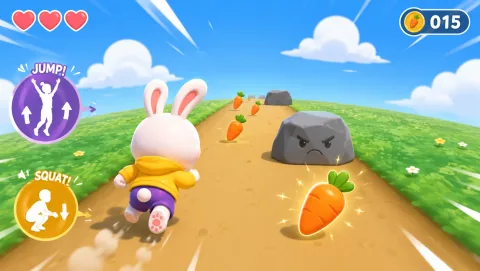
Brain-and-body games combine a thinking task with physical action: remember a sequence while moving, react to a target, follow a rhythm, or choose the correct movement based on a cue.
They can be enjoyable and challenging, but the evidence should be described carefully. Research on exergames in older adults is promising rather than definitive.
Simple rules do not require childish presentation. Everyday engagement can be valuable on its own without making claims about treatment, cognition, or fall prevention. That flexibility is what makes a format usable across very different days and participants.
Movement memory
Create a sequence of hand or body movements and add one action each round. The challenge is remembering the order as well as performing it.
Short rounds make rest easier and reduce the social pressure to continue when someone is tired.
Mixed ability is normal in older-adult groups, not an edge case. Everyday engagement can be valuable on its own without making claims about treatment, cognition, or fall prevention. That flexibility is what makes a format usable across very different days and participants.
Color-response game
Assign one action to each color. Show colors in changing order and respond with the matching movement.
A good activity can stay challenging while becoming easier to access physically. Everyday engagement can be valuable on its own without making claims about treatment, cognition, or fall prevention. That flexibility is what makes a format usable across very different days and participants.
Number targets
Touch or point to numbers in ascending, descending, or alternating order.
The useful design question is how much choice the participant has. Everyday engagement can be valuable on its own without making claims about treatment, cognition, or fall prevention. That flexibility is what makes a format usable across very different days and participants.
Rhythm imitation:
Copy increasingly complex clap, tap, or step patterns.
Dual-category game:
Call an animal or food while showing a direction. The player must answer the category and move in the correct direction.
Motion-controlled digital games:
Reaction, pose, and sequence games can combine visual decisions with movement. A webcam platform such as MovePlay can provide this kind of interaction when the game matches the player’s mobility and vision.
What the research says
A 2026 systematic review and meta-analysis of 10 randomized trials involving 690 community-dwelling older adults found a small statistically significant overall cognitive benefit from exergames, while several specific cognitive domains did not show clear significant effects. Other reviews describe encouraging findings but emphasize limited study quality and the need for more research.
That is a reason to be interested—not a basis for claiming that a consumer game prevents dementia or preserves cognition.
Use brain-and-body games as recreational activity with cognitive challenge. For clinical concerns about memory or cognition, seek appropriate professional assessment rather than relying on a game.
Activities for older adults should begin with the person, not the age label. Large cues, generous timing, short rounds, and seated or standing options reduce unnecessary barriers without removing humor or challenge. The most meaningful signal is often whether people want another round.
Choose it for the group in front of you
Best fit: this works when the ages and confidence levels can share one simple goal, with an adult able to explain the first round and step in if the room loses focus.
Limit: it is a weaker choice when children are tired, the ages are far apart, or one person is expected to perform in front of everyone. A quieter role or a shorter round may be the better answer.
If you are choosing: start with the smallest version that can succeed in the available space. Add speed, scoring, or competition only after the group understands the basic action.