Balance-oriented motion games use controlled leaning, weight shifting, slow stepping, or pose holding rather than speed alone.
Physical difficulty and game difficulty do not have to be the same thing. Players need to know whether they missed the target or the system missed the movement, otherwise every failure feels like bad tracking. That is what makes the body feel like a usable controller rather than a calibration exercise.
Useful mechanics
Center-the-body games
Move a cursor or character by shifting left, right, forward, or back.
Hold-a-pose challenges
Maintain a stable position while a timer or progress bar fills.
Slow directional steps
Move between large zones without rushing.
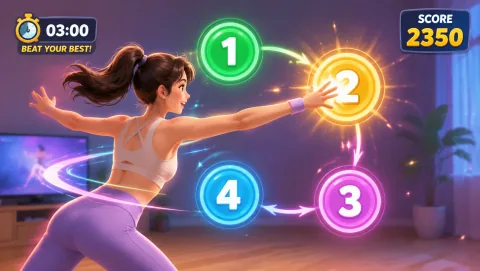
Reach while staying centered
Touch targets while trying to keep the rest of the body stable.
Readable feedback is part of the control scheme, not decoration. Players need to know whether they missed the target or the system missed the movement, otherwise every failure feels like bad tracking. That is what makes the body feel like a usable controller rather than a calibration exercise.
A strong motion mechanic makes the connection between body and screen obvious. Re-centering moments and short rounds help people recover from drift, missed inputs, and awkward starting positions. That is what makes the body feel like a usable controller rather than a calibration exercise.
The player should not have to think constantly about how the tracking system works. Re-centering moments and short rounds help people recover from drift, missed inputs, and awkward starting positions. That is what makes the body feel like a usable controller rather than a calibration exercise.
Avoid pretending a game is a balance assessment
A webcam can observe visible movement, but casual game performance is affected by camera angle, timing, familiarity, and strategy. It should not be used to diagnose balance problems.
Good motion design filters out movement that does not matter to the game. Re-centering moments and short rounds help people recover from drift, missed inputs, and awkward starting positions. That is what makes the body feel like a usable controller rather than a calibration exercise.
Physical difficulty and game difficulty do not have to be the same thing. Re-centering moments and short rounds help people recover from drift, missed inputs, and awkward starting positions. That is what makes the body feel like a usable controller rather than a calibration exercise.
Give players an easy exit
No score is worth a fall. Use a clear area and let players choose a seated or lower-movement alternative.
Readable feedback is part of the control scheme, not decoration. Re-centering moments and short rounds help people recover from drift, missed inputs, and awkward starting positions. That is what makes the body feel like a usable controller rather than a calibration exercise.
Difficulty should come from control
Longer holds, more complex reach patterns, or smaller movement zones create challenge without forcing rapid stepping.
Balance-oriented gameplay can be calm and engaging, but it needs conservative design and clear physical boundaries.
A strong motion mechanic makes the connection between body and screen obvious. Reach, dodge, pose, rhythm, and squat controls work best when the on-screen result matches what the movement naturally suggests. A mechanic is strongest when it remains clear even for a first-time player.
Judge the format by the device and the room
Best fit: start here when the device is already available, the camera view is understandable, and the activity can be completed without moving furniture or sharing more video than necessary.
Limit: it is a weaker choice when the connection is unstable, the frame is crowded, the light makes tracking unreliable, or the player needs a movement the camera cannot read consistently.
If you are choosing: If you are choosing between a digital and an offline version, test the first cue before choosing the game. Use the offline option when it gives clearer feedback or a more comfortable way to participate.