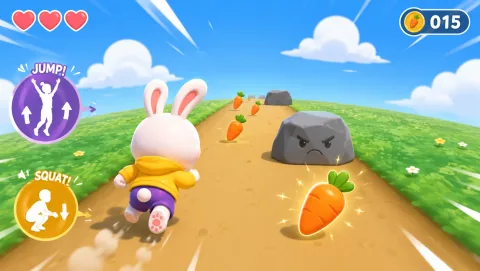
Adaptive PE activities are strongest when the learning goal survives even if the movement changes. A student should be able to practice reaction, accuracy, rhythm, coordination, or teamwork without jumping being the price of participation.
Adults can improve the format without controlling every minute of it. A stable format can be reused with different prompts or themes without forcing adults to invent a completely new activity each time. A little structure should make play easier, not turn it into another lesson.
Seated target reach
Place or display targets in comfortable reach zones. Students touch, point, tap, or direct a soft object toward them.
Difficulty can increase through sequence, color rules, memory, or timing rather than greater range.
Avoid over-explaining. Demonstrating one round is often faster than giving a long verbal set of rules.
Children's activities change when the social setting changes. Short turns, demonstration instead of long explanation, and clear goals help children understand the loop before attention drifts. Good group design prevents predictable conflict before it needs managing.
No-jump reaction zones
Use stepping, leaning, pointing, or hand signals instead of jumping between zones. The game still trains response and decision-making.
The same game can behave very differently with siblings, friends, or a preschool group. Short turns, demonstration instead of long explanation, and clear goals help children understand the loop before attention drifts. Good group design prevents predictable conflict before it needs managing.
Rhythm from a chair
Clap, tap, reach, or use lightweight instruments. Students can copy patterns, lead rounds, and build sequences.
Waiting time is one of the most common hidden problems in children's group activities. Short turns, demonstration instead of long explanation, and clear goals help children understand the loop before attention drifts. Good group design prevents predictable conflict before it needs managing.
Accuracy challenges:
Use beanbags, soft balls, rings, or virtual targets. Move targets closer or farther based on individual needs.
Cooperative roles:
One student performs an action, another tracks points, another chooses the next target, and another times the round. Rotate roles so participation is broader than movement alone.
Digital activities:
Camera-based games may be useful if they accept seated or upper-body control and use large targets. Test the exact game with the intended setup before putting it into a lesson plan.
Keep professional judgment central
Adaptive PE can involve individualized goals and accommodations. General activity ideas should not replace the judgment of qualified PE, special education, therapy, or medical professionals when specific needs are involved.
A good adaptation keeps the activity recognizable while changing the barrier—not the student’s right to participate.
For younger children, a quick first success matters more than a sophisticated rule set. Short turns, demonstration instead of long explanation, and clear goals help children understand the loop before attention drifts. Good group design prevents predictable conflict before it needs managing.
Make the activity work in the real timetable
Best fit: use this when the teacher can explain one visible rule, keep the first turn brief, and give students a clear way to watch, lead, or pause without being singled out.
Limit: it is a poor fit when setup takes longer than the learning goal, the room cannot be reset safely, or the scoring rewards speed over control. A lower-tech version may teach the same idea better.
If you are choosing: If you are choosing between formats, begin with the option that needs the fewest materials and the least movement across the room. Test one round before committing the whole class.