Active screen time should change as children grow. A preschooler needs simple rules and large visible actions. An older child may need challenge, competition, strategy, or a game that does not feel designed for little kids.
Age ranges are only a starting point; individual interest and motor ability matter more than a birthday cutoff.
The label on the app matters less than the behavior it produces. The same device can be part of a creative hour or part of a passive one; context decides which it is. The point is balance and intention, not finding a loophole around screen limits.
Formats worth considering
Ages 3–4: copy, move, stop
Keep the screen secondary and the action simple.
Good formats include:
- follow-the-leader movement;
- short dance songs;
- animal-motion videos;
- simple pose imitation;
- color or shape movement cues.
At this age, adult participation and supervision matter more than scores.
Try it for one clearly bounded session before deciding whether it deserves a regular place in the routine.
Ages 5–7: immediate feedback
Children in this range often respond well to games where one movement clearly causes one result.
Try:
- whack-a-mole style reaching;
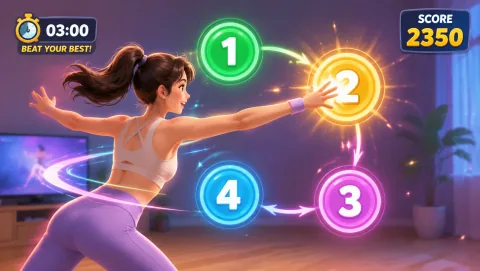
- simple dance games;
- target touch;
- easy obstacle or dodge games;
- short follow-along movement stories.
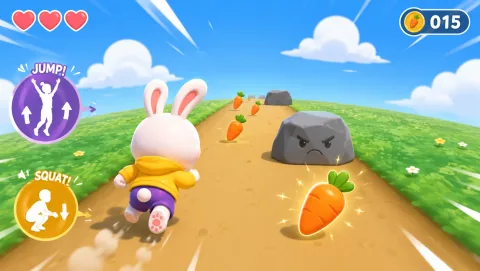
MovePlay’s Whack A Mole, Fruit Slash, and BunnyHop are examples of simple motion-to-result loops. Check the individual game and the child rather than assuming every title fits every five-year-old.
When evaluating digital play, I would look past the word 'educational' or 'active' on the product page. The same device can be part of a creative hour or part of a passive one; context decides which it is. The point is balance and intention, not finding a loophole around screen limits.
Ages 7–9: scores, sequences, and choices
Add more challenge:
- reaction games;
- movement memory;
- rhythm;
- high-score attempts;
- games with more than one action;
- cooperative family play.
Children can also start managing setup with less adult help, depending on the device and household rules.
If the child enjoys the format but not the specific title, change the game before changing the entire category.
Teens: treat them like players, not “active kids”
For teenagers, the game has to stand on its own. Fitness benefits are unlikely to rescue weak gameplay.
Reaction, rhythm, party, sports, and challenge formats usually make more sense than cartoonish “movement breaks.”
For family use, consider whether another person can understand what is happening without needing their own device.
How I would judge the screen activity
Screen time becomes easier to reason about when you stop treating every screen activity as the same thing. Parents still need to protect sleep, offline play, social time, and periods where no device is directing attention. The point is balance and intention, not finding a loophole around screen limits.
Ages 9–12: avoid anything that feels babyish
Older kids often care as much about presentation as the movement itself.
Look for:
- faster reaction challenges;
- competitive scores;
- rhythm and sports themes;
- skill progression;
- games they can play with siblings or friends;
- active alternatives to fitness videos.
Screen guidance still depends on the whole day
The fact that a screen activity includes movement does not make duration irrelevant. Sleep, outdoor activity, schoolwork, social time, and the child’s overall routine still matter.
Choose active screen time the way you would choose any activity: by age, interest, context, and whether the child wants to come back to it.
This is a good option when music itself is motivating. It is a weaker fit for children who dislike performing choreography; in that case, reaction or arcade-style movement may feel more like a game and less like a class.
One thing I would not ignore
For parents, the more useful distinction is what the child is doing with the screen. Parents still need to protect sleep, offline play, social time, and periods where no device is directing attention. The point is balance and intention, not finding a loophole around screen limits.
How I would think about it
A screen can support very different behaviors, from passive viewing to creating, talking, solving, or moving. Parents still need to protect sleep, offline play, social time, and periods where no device is directing attention. The point is balance and intention, not finding a loophole around screen limits.
Make the activity work in the real timetable
Best fit: use this when the teacher can explain one visible rule, keep the first turn brief, and give students a clear way to watch, lead, or pause without being singled out.
Limit: it is a poor fit when setup takes longer than the learning goal, the room cannot be reset safely, or the scoring rewards speed over control. A lower-tech version may teach the same idea better.
If you are choosing: If you are choosing between formats, begin with the option that needs the fewest materials and the least movement across the room. Test one round before committing the whole class.