Active play in preschool does not need to look like a miniature fitness class. The strongest activities combine simple movement, imagination, repetition, and enough choice for children to stay engaged.
Children's activities change when the social setting changes. Long individual turns, elimination, and unclear scoring can manufacture conflict even when the children themselves were ready to cooperate. A little structure should make play easier, not turn it into another lesson.
Movement stories
Tell a short story with actions: climb the hill, duck under a branch, carry a giant pumpkin, tiptoe past a sleeping animal, reach for a star.
The story gives the movement a reason.
The same game can behave very differently with siblings, friends, or a preschool group. Long individual turns, elimination, and unclear scoring can manufacture conflict even when the children themselves were ready to cooperate. A little structure should make play easier, not turn it into another lesson.
Waiting time is one of the most common hidden problems in children's group activities. Long individual turns, elimination, and unclear scoring can manufacture conflict even when the children themselves were ready to cooperate. A little structure should make play easier, not turn it into another lesson.
For younger children, a quick first success matters more than a sophisticated rule set. Long individual turns, elimination, and unclear scoring can manufacture conflict even when the children themselves were ready to cooperate. A little structure should make play easier, not turn it into another lesson.
Follow-and-change
Start with one repeated movement and change only one thing at a time: march slowly, march fast, march quietly, march with high knees.
This is easier for young children than long multi-step sequences.
Avoid over-explaining. Demonstrating one round is often faster than giving a long verbal set of rules.
Build a movement corner
Keep reusable prompts available: pose cards, floor spots, a soft ball, a balance line, or picture cues. Children can return to familiar activities without waiting for a formal lesson.
Adults can improve the format without controlling every minute of it. Long individual turns, elimination, and unclear scoring can manufacture conflict even when the children themselves were ready to cooperate. A little structure should make play easier, not turn it into another lesson.
Pair movement with concepts
Use shapes, colors, counting, opposites, and simple vocabulary. “Make a wide shape,” “take three steps,” or “find something red and touch your knees” keeps the learning light and physical.
Children's activities change when the social setting changes. Team scores, shared goals, and meaningful roles for the waiting child often fix the structure more effectively than adding more rules. A little structure should make play easier, not turn it into another lesson.
Use technology selectively:
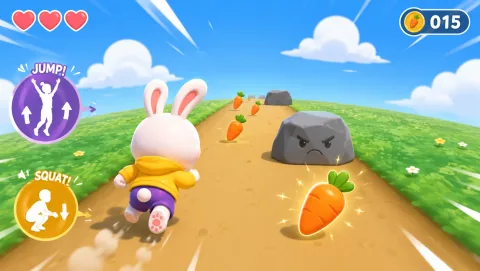
A screen can support movement when it reacts to the child rather than asking them to sit and watch. Simple camera games or projected target activities can add variety, but they should not replace free play, outdoor activity, or teacher-led movement.
Plan for different confidence levels
Some children will copy immediately; others prefer to watch first. Allow observing, smaller movements, and repeated demonstrations.
The goal is not performance. It is to make moving feel normal, playful, and easy to join.
The same game can behave very differently with siblings, friends, or a preschool group. Team scores, shared goals, and meaningful roles for the waiting child often fix the structure more effectively than adding more rules. A little structure should make play easier, not turn it into another lesson.
Make the activity work in the real timetable
Best fit: use this when the teacher can explain one visible rule, keep the first turn brief, and give students a clear way to watch, lead, or pause without being singled out.
Limit: it is a poor fit when setup takes longer than the learning goal, the room cannot be reset safely, or the scoring rewards speed over control. A lower-tech version may teach the same idea better.
If you are choosing: If you are choosing between formats, begin with the option that needs the fewest materials and the least movement across the room. Test one round before committing the whole class.