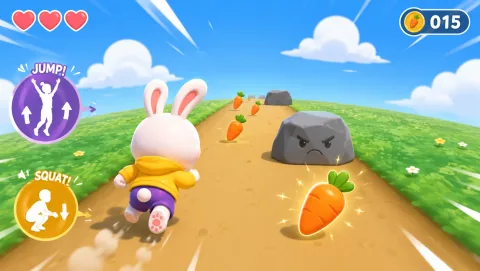
Active party games should give excited kids somewhere to put their energy without turning the room into uncontrolled running. Short rounds, clear boundaries, and no elimination make the host’s job much easier.
Mixed-age groups expose weaknesses in a game very quickly. Spectator-friendly feedback and obvious goals help grandparents, children, and guests join at their own pace. When the group stays engaged between turns, the game has solved the harder social problem.
Games that keep the room moving
Freeze dance
Use several short songs. Instead of removing anyone who moves, give them a funny challenge and keep them in the game.
If a round lasts more than a few minutes, think about what the rest of the room is doing during that time.
Balloon volleyball
Create a simple center line and play in small teams. For very young children, skip formal scoring and count consecutive hits.
A family game is partly about the people who are not holding the controller. Spectator-friendly feedback and obvious goals help grandparents, children, and guests join at their own pace. When the group stays engaged between turns, the game has solved the harder social problem.
Animal relay
Use a short, safe route and switch movement each round: bear walk, giant steps, penguin walk, frog jumps.
A good party version removes elimination and shortens recovery time after a mistake.
Target stations
Set up baskets or floor zones and use rolled socks or soft objects. Children rotate through rather than all throwing at once.
If the group is larger than expected, split into teams or stations rather than making one queue longer.
Move-and-react game
Call commands such as high, low, left, right, and freeze. Speed up gradually.
Run one practice round before keeping score. It is faster than explaining every edge case while people are waiting.
Webcam challenge station
A screen-based motion station can add variety, especially when one child plays and others watch. Reaction and pose games are usually better for parties than long fitness sessions.
With MovePlay, keep each turn to one short round and use a visible queue. Test camera position before the party.
Team movement memory
Each team creates a movement sequence. The other team gets one attempt to copy it.
Human shape challenge
Call a letter, number, animal, or object and ask teams to create the shape with their bodies.
What matters once people arrive:
The social rhythm matters as much as the rules. Spectator-friendly feedback and obvious goals help grandparents, children, and guests join at their own pace. When the group stays engaged between turns, the game has solved the harder social problem.
Keep children moving after mistakes:
Avoid games where a mistake means sitting out for ten minutes. Use retries, points, or team totals instead.
Match the game to the venue
A large hall can handle running relays. A living room cannot. In small spaces, use reaches, squats, poses, and stepping.
The most successful active party game is not the one that produces the most movement. It is the one that stays fun and manageable through the whole round.
One thing I would not ignore
For a household or gathering, I would judge the game by the whole room rather than the most competitive player. Spectator-friendly feedback and obvious goals help grandparents, children, and guests join at their own pace. When the group stays engaged between turns, the game has solved the harder social problem.
A good party game earns another round
Family play works best when it leaves room for different ages and different levels of enthusiasm. The strongest formats let people drift in and out without needing the event to stop and restart. When the group stays engaged between turns, the game has solved the harder social problem.
Keep the social pressure lower than the benefit
Best fit: this is useful when people can join for a short reset, understand the invitation immediately, and leave without having to explain why they are sitting out.
Limit: it is a poor choice when participation is treated as a performance, the activity competes with a serious meeting, or colleagues have very different comfort levels with cameras and movement.
If you are choosing: If you are choosing between ideas, prefer a short optional round with a personal target over a public leaderboard. The goal is an easier break, not another workplace metric.