Some kids find long periods of sitting genuinely difficult. When that energy shows up at home, the answer is not always “try harder to be still.” Sometimes the more useful move is to give the child a short, structured reason to move.
These games work in limited indoor space and can be adjusted for noise, age, and energy level.
For family use, I would put ease of starting ahead of novelty. The best choice changes with energy: restless children need an outlet; tired children may need structure and calm instead. That is the difference between an idea worth saving and one that only works once.
Games I would try first
Reaction targets
Place or imagine targets at different heights and sides of the body. Call a sequence—left, right, high, low—and have the child touch them in order.
To make it harder, add colors or numbers and ask the child to respond only to certain cues.
The practical test is what happens after the first burst of excitement. The best choice changes with energy: restless children need an outlet; tired children may need structure and calm instead. That is the difference between an idea worth saving and one that only works once.
Move on the cue
Choose four actions such as squat, reach, side step, and freeze. Call them at random. The unpredictability is what keeps the game engaging.
With children, the room and the timing matter as much as the idea itself. The best choice changes with energy: restless children need an outlet; tired children may need structure and calm instead. That is the difference between an idea worth saving and one that only works once.
Webcam movement games
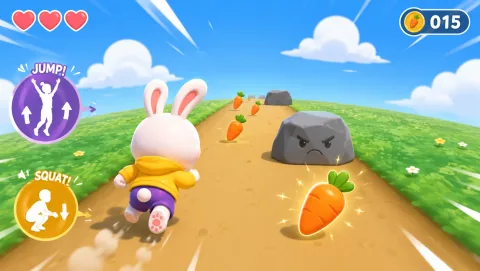
A motion-controlled game can be useful when the child likes screens but you want more physical participation. MovePlay’s Reaction and Fruit Slash emphasize reaching and arm movement; BunnyHop and SquatPacman add more lower-body work and require more room.
The screen is not the advantage by itself. The advantage is immediate feedback: the child moves and something in the game responds.
A parent usually needs something that works under ordinary conditions, not a perfect activity day. The best choice changes with energy: restless children need an outlet; tired children may need structure and calm instead. That is the difference between an idea worth saving and one that only works once.
Slow-motion challenges
Kids who struggle to sit still do not always need maximum-speed activity. Slow movement can be surprisingly demanding.
Try:
- cross the room as slowly as possible;
- copy a slow movement exactly;
- hold a funny pose for ten seconds;
- walk heel-to-toe along an imaginary line.
These games add body control without asking for complete stillness.
In a real home, the deciding factor is often not how creative an activity sounds but how quickly a child can understand it. Watch whether the child asks for another round without prompting; that is better evidence than how impressive the idea looks. That is the difference between an idea worth saving and one that only works once.
How I would choose
For family use, I would put ease of starting ahead of novelty. Watch whether the child asks for another round without prompting; that is better evidence than how impressive the idea looks. That is the difference between an idea worth saving and one that only works once.
Balloon keep-up
A balloon slows the action enough for indoor use while still creating constant movement. Add rules such as alternating hands or keeping both feet inside a marked area.
The practical test is what happens after the first burst of excitement. Watch whether the child asks for another round without prompting; that is better evidence than how impressive the idea looks. That is the difference between an idea worth saving and one that only works once.
Use movement before a seated task
If homework, reading, or dinner is coming next, a short active block can create a clearer transition. Keep it predictable: five minutes of movement, water, then the seated activity.
Avoid turning this into a reward-and-punishment system in which movement is earned only after sitting “properly.” Movement is a normal need, not a prize.
If a child’s difficulty sitting still is persistent across settings or is causing significant problems, games are not a diagnosis or treatment. They are simply one practical way to build movement into the day.
One thing I would not ignore
With children, the room and the timing matter as much as the idea itself. Watch whether the child asks for another round without prompting; that is better evidence than how impressive the idea looks. That is the difference between an idea worth saving and one that only works once.
When it is worth repeating:
The aim is not to manufacture exhaustion. Give the energy a job, then make the next transition easier.
Choose it for the group in front of you
Best fit: this works when the ages and confidence levels can share one simple goal, with an adult able to explain the first round and step in if the room loses focus.
Limit: it is a weaker choice when children are tired, the ages are far apart, or one person is expected to perform in front of everyone. A quieter role or a shorter round may be the better answer.
If you are choosing: start with the smallest version that can succeed in the available space. Add speed, scoring, or competition only after the group understands the basic action.