Small apartments change the definition of an “active” game. Running laps, throwing balls across the room, and building obstacle courses may not be realistic. The useful movements are the ones that create activity without requiring much travel: reaching, squatting, stepping, balancing, swiping, and controlled jumping where appropriate.
The practical test is what happens after the first burst of excitement. If the child needs constant correction or adult help, the activity is less independent than it looked on the list. Good indoor play should fit the household rather than take it over.
Think about neighbors as well as furniture
Apartment-friendly often means low noise. Replace jumps with calf raises, steps, reaches, squats, or controlled knee lifts. Avoid repeated stomping, especially early or late in the day.
Keep the first round short. If the child immediately asks to do it again, repeat before adding more rules.
Do not force an activity that does not fit
If the room is too tight for a particular game, choose a different movement pattern. The goal is not to prove that every game can happen anywhere.
Small-space play works best when the activity is designed around the actual room rather than when the furniture is treated as an inconvenience to work around.
With children, the room and the timing matter as much as the idea itself. If the child needs constant correction or adult help, the activity is less independent than it looked on the list. Good indoor play should fit the household rather than take it over.
How I would choose
A parent usually needs something that works under ordinary conditions, not a perfect activity day. If the child needs constant correction or adult help, the activity is less independent than it looked on the list. Good indoor play should fit the household rather than take it over.
Use a movement footprint, not the whole room
Pick a safe zone where the child can extend both arms without hitting furniture. That is enough for many games.
Activities that fit well include:
- high-low reaching;
- side-step commands;
- squat-and-stand games;
- balance poses;
- freeze dance with a “stay on the rug” rule;
- mirror movement;
- balloon taps if the ceiling and furniture allow it.
Choose vertical movement over distance
Squatting, knee lifts, reaching overhead, and changing levels create substantial movement without crossing the room.
A simple five-minute pattern could be:
- 30 seconds marching;
- 30 seconds high reaches;
- 30 seconds squats;
- 30 seconds side steps;
- repeat once;
- finish with balance.
Camera games can work if framing works
Webcam games do not automatically solve a space problem. Full-body tracking still needs enough distance for the camera to see the player.
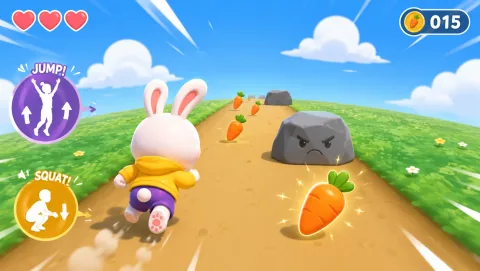
If your room is tight, choose upper-body or hand-led games before jump-heavy ones. On MovePlay, Fruit Slash and Whack A Mole can work with a smaller movement footprint than BunnyHop. The current webcam-games guide recommends roughly two meters for full-body play, while seated and hand-focused games need less space.
Use one-screen turn-taking for siblings
If two children share the room, avoid having both move at full speed at the same time. Use short rounds: one plays, one keeps score or calls cues, then switch.
This also reduces the amount of clear space required.
In a real home, the deciding factor is often not how creative an activity sounds but how quickly a child can understand it. A five-minute game that starts cleanly can be more useful than a complicated project that consumes the whole afternoon. Good indoor play should fit the household rather than take it over.
One thing I would not ignore:
For family use, I would put ease of starting ahead of novelty. A five-minute game that starts cleanly can be more useful than a complicated project that consumes the whole afternoon. Good indoor play should fit the household rather than take it over.
When it is worth repeating:
The aim is not to manufacture exhaustion. Give the energy a job, then make the next transition easier.
Choose it for the group in front of you
Best fit: this works when the ages and confidence levels can share one simple goal, with an adult able to explain the first round and step in if the room loses focus.
Limit: it is a weaker choice when children are tired, the ages are far apart, or one person is expected to perform in front of everyone. A quieter role or a shorter round may be the better answer.
If you are choosing: start with the smallest version that can succeed in the available space. Add speed, scoring, or competition only after the group understands the basic action.