If you already like games but dislike conventional workouts, active gaming changes the reason for moving. The goal becomes beating a level, landing a rhythm sequence, reacting faster, or outscoring someone—not completing a set because a timer says so.
Active games still have to satisfy the reasons people like games in the first place. Clear goals, score, timing, progression, and room for skill improvement make movement feel like input rather than homework. That is a stronger motivation loop than telling a gamer they ought to move more.
VR action and rhythm games
VR offers the strongest sense of being inside the game. Rhythm, boxing, swordplay, and sports titles can create substantial movement.
The trade-offs are headset cost, comfort, heat, and room setup.
Gamers notice quickly when movement is only a fitness tax pasted onto a weak game loop. Clear goals, score, timing, progression, and room for skill improvement make movement feel like input rather than homework. That is a stronger motivation loop than telling a gamer they ought to move more.
Hardware matters less when the core loop is compelling. Start with what you already own before buying a new ecosystem.
It is fine for active games to sit beside ordinary games rather than compete with them. A few short rounds can become a break between longer seated sessions, or a social option when friends are in the room. That is a more realistic role than expecting one product to replace every other kind of game.
Console motion games
Sports and party games on systems such as Nintendo Switch are good for social play and polished local multiplayer. They use tracked controllers rather than camera-only full-body input.
Short arcade-style rounds work well because players can chase improvement without committing to a long session.
Webcam browser games
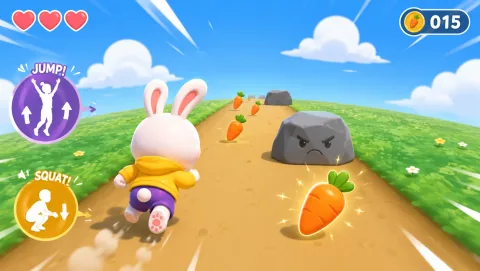
A webcam game is the low-hardware option. You use a laptop or desktop camera and move in front of the screen. Reaction, swipe, squat, pose, and dodge mechanics work especially well for short sessions.
Tracking is less specialized than VR or dedicated sensors, but setup can be much lighter.
The interesting question is how movement changes play, not whether the product can be called exercise. Clear goals, score, timing, progression, and room for skill improvement make movement feel like input rather than homework. That is a stronger motivation loop than telling a gamer they ought to move more.
Dance and rhythm without a headset:
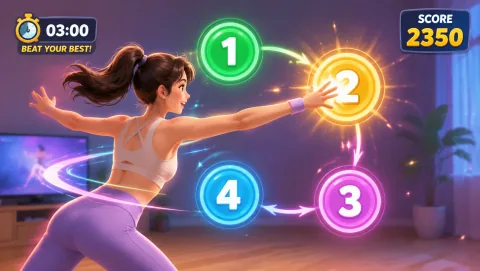
Dance games and music-driven challenges are a good fit if rhythm is more motivating than competition or fitness metrics.
Real-world skill games:
Table tennis, badminton, climbing, pickleball, and casual sports keep the “game” part while moving the activity away from the screen.
Choose the mechanic you would replay
Do not start by asking which game burns the most calories. Ask what makes you want another round: progression, leaderboard, music, precision, competition, story, or mastery.
The best active game for a gamer is the one that preserves the reason you already enjoy games while changing how much of your body participates.
The useful test is whether you would choose to play it again even if nobody called it exercise. If the answer is yes and you happened to move more, the game has solved a real motivation problem.
Judge the format by the device and the room
Best fit: start here when the device is already available, the camera view is understandable, and the activity can be completed without moving furniture or sharing more video than necessary.
Limit: it is a weaker choice when the connection is unstable, the frame is crowded, the light makes tracking unreliable, or the player needs a movement the camera cannot read consistently.
If you are choosing: If you are choosing between a digital and an offline version, test the first cue before choosing the game. Use the offline option when it gives clearer feedback or a more comfortable way to participate.