A good beginner active game should make the first minute easy. Complex controls, high fitness demands, or a score that immediately makes you feel bad are poor introductions.
Look for clear movement, short rounds, and room to improve.
The useful question is what you would still do on a busy or low-energy day. Short walks, a few active game rounds, music, mobility work, or a simple skill can all fit without turning the day into a training plan. The aim is to make movement easier to return to.
Low-friction ways to move
Reaction games
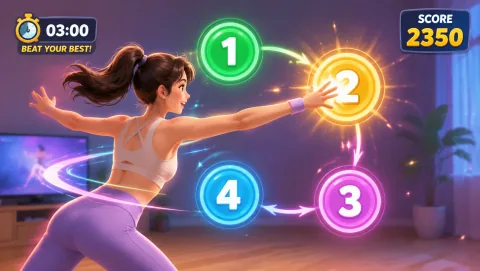
Target-hitting and whack-a-mole formats are easy to understand because the goal is obvious. Reach, tap, or move toward the target.
These are good first choices for people who are new to motion gaming.
Many adults need a smaller commitment, not a more sophisticated workout. Short walks, a few active game rounds, music, mobility work, or a simple skill can all fit without turning the day into a training plan. The aim is to make movement easier to return to.
Rhythm games with simple patterns
Choose tracks or modes with forgiving timing. A beginner does not need the hardest choreography to get moving.
If the format is enjoyable, resist the urge to optimize it immediately into a complicated program.
Walking and stepping games
Games built around steps, marching, or light directional movement are easier to sustain than jump-heavy formats.
Use effort that feels appropriate today; tomorrow's repeat matters more than today's heroic session.
Balance and pose games
These can be lower intensity while still requiring body control. Choose comfortable ranges rather than forcing difficult poses.
A score or streak can be motivating, but it should not make you ignore discomfort or poor movement quality.
Browser motion games
Webcam games reduce hardware setup but add one new skill: understanding how the camera sees you.
For MovePlay, start with a reach or swipe game such as Fruit Slash or Whack A Mole before a more demanding full-body title. Step back until the camera can see the body parts the game needs.
For adults, the hardest part is often starting rather than knowing what movement is available. If an activity is enjoyable enough to repeat, it has an advantage over a theoretically optimal routine you keep avoiding. The aim is to make movement easier to return to.
Short sports mini-games
Bowling, light boxing, target practice, and simple racket games can be good entry points on consoles or VR systems because the action is familiar.
Attach it to a natural break in the day so you do not need a second decision about when to begin.
Judge the game after several attempts
The first round often includes setup and timing mistakes. Give yourself enough time to understand the control before deciding you are “bad at it.”
Beginner does not mean low ability forever
Choose games with a path to harder difficulty, faster reaction, or more complex movement. The best beginner game is one you can start comfortably and still find interesting after the first week.
How to make it repeatable:
A sustainable active routine usually has a very low-friction version. If an activity is enjoyable enough to repeat, it has an advantage over a theoretically optimal routine you keep avoiding. The aim is to make movement easier to return to.
One thing I would not ignore:
It helps to judge movement by repeatability before ambition. If an activity is enjoyable enough to repeat, it has an advantage over a theoretically optimal routine you keep avoiding. The aim is to make movement easier to return to.
Reduce the friction first:
The useful question is what you would still do on a busy or low-energy day. If an activity is enjoyable enough to repeat, it has an advantage over a theoretically optimal routine you keep avoiding. The aim is to make movement easier to return to.
Judge the format by the device and the room
Best fit: start here when the device is already available, the camera view is understandable, and the activity can be completed without moving furniture or sharing more video than necessary.
Limit: it is a weaker choice when the connection is unstable, the frame is crowded, the light makes tracking unreliable, or the player needs a movement the camera cannot read consistently.
If you are choosing: If you are choosing between a digital and an offline version, test the first cue before choosing the game. Use the offline option when it gives clearer feedback or a more comfortable way to participate.