An active date night at home does not need to become a couples workout. The useful middle ground is a game that gets both people standing, laughing, and competing a little without requiring special equipment.
For two people, the best active games are usually short, low-pressure, and easy to switch out. The point is to create something to do together, not to manufacture competition if neither person wants it.
Low-pressure ways to play together
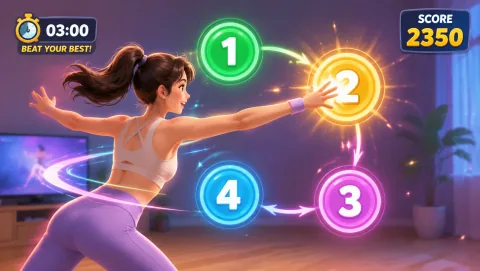
Dance challenge
Choose one song each. Copy the other person’s moves or use a dance game if you prefer prompts over freestyle.
Alternating short turns usually feels better than one person performing for several minutes while the other watches. If you both prefer cooperation, use a shared score or challenge instead of forcing a winner.
Reaction best-of-five
Use a reaction app, target game, or webcam motion game. Take five short rounds and track wins rather than total score.
Choose something both people can understand quickly so the conversation stays part of the evening rather than disappearing into rules.
Blind movement copy
One person creates a sequence of four moves. The other watches once, then tries to reproduce it.
A little silliness helps more than perfect technique here.
Home mini golf
Create one or two holes using safe household objects. Keep it compact and avoid anything breakable.
Stop while it still feels like a shared activity, not a test of who is better at the mechanic.
Sock target game
Use baskets or floor zones with different point values. Increase the distance after each successful round.
One short round is enough to see whether the mood fits; you do not need to commit the whole evening to the activity.
Motion game tournament
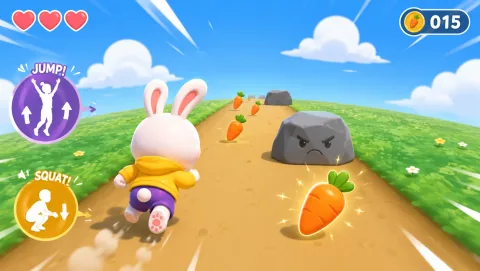
A browser camera game can work if both people enjoy arcade-style challenges. MovePlay offers reaction, swipe, squat, and pose formats; choose two or three contrasting games instead of playing one for a long time.
If competition changes the tone in a bad way, switch to a shared score or a cooperative target.
Cooperative challenge
Set a shared target: 100 balloon taps, a combined score, a ten-move memory chain, or a puzzle completed under a time limit.
How to keep it relaxed:
You also do not need to make the whole evening 'active.' One or two short games between food, conversation, music, or another activity is enough to change the rhythm of the night.
Make it a date, not a performance test
If one person is much fitter or more coordinated, use handicaps or cooperative scoring. The point is to create interaction, not to discover who can do more squats.
An active game is especially useful on an at-home evening when the alternative is automatically putting on another film. It gives the night a little structure while still leaving plenty of time for dinner, conversation, or whatever comes next.
One thing I would not ignore:
If a game starts creating more tension than fun, drop it. Date-night activities are there to give the evening texture, not to test the relationship under competitive pressure.
The point is shared experience:
If the activity gives you something to laugh about, compete over lightly, or solve together, it has done enough. It does not need to carry the entire evening.
Choose it for the group in front of you
Best fit: this works when the ages and confidence levels can share one simple goal, with an adult able to explain the first round and step in if the room loses focus.
Limit: it is a weaker choice when children are tired, the ages are far apart, or one person is expected to perform in front of everyone. A quieter role or a shorter round may be the better answer.
If you are choosing: start with the smallest version that can succeed in the available space. Add speed, scoring, or competition only after the group understands the basic action.