A five-minute movement break is useful when you have been working, gaming, reading, or sitting for a long stretch but do not want to start a full workout.
The best break is the one you can begin without preparation.
For adults, the hardest part is often starting rather than knowing what movement is available. If an activity is enjoyable enough to repeat, it has an advantage over a theoretically optimal routine you keep avoiding. That is a more useful foundation for a habit than chasing perfect sessions.
Low-friction ways to move
Five-minute mobility reset
Spend about one minute each on:
- shoulder rolls and arm circles;
- overhead reaches;
- gentle torso turns;
- slow squats or sit-to-stands;
- calf raises and ankle movement.
Keep the range comfortable rather than forcing a stretch.
Attach it to a natural break in the day so you do not need a second decision about when to begin.
One-song movement break
Put on one song and move until it ends. Walk, dance, march, or follow the beat.
No tracking or routine is required.
If the format is enjoyable, resist the urge to optimize it immediately into a complicated program.
Reaction break
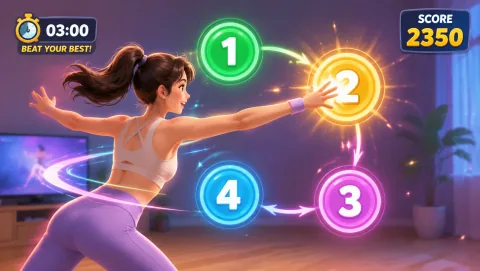
Use visual targets, a simple app, or a webcam game for a few short rounds. MovePlay’s Reaction and Whack A Mole emphasize reaching; they are useful when you want the break to feel more like play than exercise.
Use effort that feels appropriate today; tomorrow's repeat matters more than today's heroic session.
Walk-and-water break
Stand up, refill water, and walk around the home for the remaining time. This is unremarkable—and easy enough to repeat several times a day.
A score or streak can be motivating, but it should not make you ignore discomfort or poor movement quality.
Squat-and-reach ladder
Do a comfortable squat or sit-to-stand, then reach overhead. Repeat at your own pace for 30–45 seconds, rest, and repeat.
A sustainable active routine usually has a very low-friction version. If an activity is enjoyable enough to repeat, it has an advantage over a theoretically optimal routine you keep avoiding. That is a more useful foundation for a habit than chasing perfect sessions.
Quiet apartment break
If noise matters, use heel raises, side steps, controlled knee lifts, reaching, and balance instead of jumping.
How to make it repeatable:
It helps to judge movement by repeatability before ambition. If an activity is enjoyable enough to repeat, it has an advantage over a theoretically optimal routine you keep avoiding. That is a more useful foundation for a habit than chasing perfect sessions.
Put the end on the calendar too
A five-minute break should stay five minutes when you need to return to work. Use a timer or choose an activity with a built-in ending, such as one song or three game rounds.
Short movement does not replace a broader exercise routine, but it can interrupt long periods of sitting. Public-health guidance recognizes that activity accumulated in bouts of any length can count toward total physical activity.
That makes five minutes worth using rather than dismissing because it is not a “real workout.”
One thing I would not ignore
The useful question is what you would still do on a busy or low-energy day. If an activity is enjoyable enough to repeat, it has an advantage over a theoretically optimal routine you keep avoiding. That is a more useful foundation for a habit than chasing perfect sessions.
Short and repeatable wins
Many adults need a smaller commitment, not a more sophisticated workout. If an activity is enjoyable enough to repeat, it has an advantage over a theoretically optimal routine you keep avoiding. That is a more useful foundation for a habit than chasing perfect sessions.
Judge the format by the device and the room
Best fit: start here when the device is already available, the camera view is understandable, and the activity can be completed without moving furniture or sharing more video than necessary.
Limit: it is a weaker choice when the connection is unstable, the frame is crowded, the light makes tracking unreliable, or the player needs a movement the camera cannot read consistently.
If you are choosing: If you are choosing between a digital and an offline version, test the first cue before choosing the game. Use the offline option when it gives clearer feedback or a more comfortable way to participate.