When students are restless, five minutes is long enough to change the room and short enough to protect lesson time. The key is to choose an activity that has a clear ending.
For school use, I would always think about the ending before starting the activity. Rules should be fast to explain, participation should not create a long queue, and the room needs a clear route back to learning. That is what turns a fun idea into a classroom tool.
Activities that work in a real classroom
1. Four-direction movement
Students stand beside their desks. Call high, low, left, right, and freeze. Increase the pace for two minutes, then slow down for the final 30 seconds.
Set the finish signal before the first movement so students know exactly what happens when the round ends.
2. Copy and add
Perform one movement. Students copy. Add a second, then a third. Continue until the class reaches a sequence of six or eight actions.
In a classroom, an activity has to work for the teacher as well as the students. A final freeze, countdown, seated cue, or retrieval question can make a two-minute break genuinely useful instead of creating five minutes of recovery. That is what turns a fun idea into a classroom tool.
3. Silent mirror pairs
Pairs face each other. One leads slow movements for 30 seconds; the other mirrors. Switch roles. Because it is silent, this works when the room is already too loud.
The most important classroom detail is often the transition nobody puts in the title. A final freeze, countdown, seated cue, or retrieval question can make a two-minute break genuinely useful instead of creating five minutes of recovery. That is what turns a fun idea into a classroom tool.
4. Reaction round
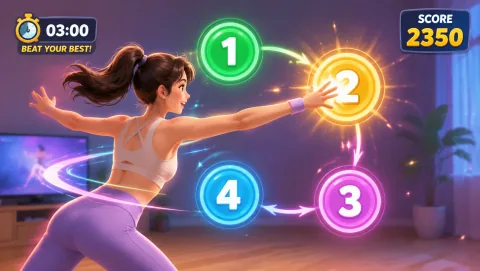
Project visual targets or call numbers and directions. Students respond by pointing, reaching, or stepping in place.
If a webcam setup is already available, a short MovePlay reaction round can be projected while the class copies or one student plays. Keep the technical setup outside the five-minute window.
Teachers benefit more from reliable formats than from endless novelty. A final freeze, countdown, seated cue, or retrieval question can make a two-minute break genuinely useful instead of creating five minutes of recovery. That is what turns a fun idea into a classroom tool.
5. Fast-to-slow reset
Use the first two minutes for marching, reaches, or side steps. Then deliberately reduce speed: slow stretches, balance, and finally sit.
This format is useful because the activity itself prepares students to stop.
A classroom game earns its place when it fits the room, the clock, and the lesson. A final freeze, countdown, seated cue, or retrieval question can make a two-minute break genuinely useful instead of creating five minutes of recovery. That is what turns a fun idea into a classroom tool.
What makes it usable for a teacher
For school use, I would always think about the ending before starting the activity. A final freeze, countdown, seated cue, or retrieval question can make a two-minute break genuinely useful instead of creating five minutes of recovery. That is what turns a fun idea into a classroom tool.
Make the return part of the break
Do not run an energetic game for four minutes and spend another four trying to regain attention. Build the ending into the instructions:
- “When the timer ends, freeze.”
- “Last round, then sit.”
- “We finish with ten silent seconds.”
Students should know how the break ends before it begins.
Avoid elimination
A restless student who is “out” in the first 20 seconds now has four minutes to become more restless. Use activities where everyone stays involved.
Five-minute brain breaks are most useful when they are predictable enough to run without negotiation. Keep three or four favorites and rotate them rather than inventing a new classroom game every day.
One thing I would not ignore:
In a classroom, an activity has to work for the teacher as well as the students. If the projector, camera, or permissions need live troubleshooting, the activity is not low-prep that day. That is what turns a fun idea into a classroom tool.
The best break has an exit:
The most important classroom detail is often the transition nobody puts in the title. If the projector, camera, or permissions need live troubleshooting, the activity is not low-prep that day. That is what turns a fun idea into a classroom tool.
Make the activity work in the real timetable
Best fit: use this when the teacher can explain one visible rule, keep the first turn brief, and give students a clear way to watch, lead, or pause without being singled out.
Limit: it is a poor fit when setup takes longer than the learning goal, the room cannot be reset safely, or the scoring rewards speed over control. A lower-tech version may teach the same idea better.
If you are choosing: If you are choosing between formats, begin with the option that needs the fewest materials and the least movement across the room. Test one round before committing the whole class.