If the word “workout” makes you postpone movement until tomorrow, use a different format. Ten minutes can be a walk, a game, a dance break, or a practical task that gets you off the chair.
For adults, the hardest part is often starting rather than knowing what movement is available. Feedback such as skill, mood, score, or simply less sitting can be more motivating in the moment than an estimated calorie number. That is a more useful foundation for a habit than chasing perfect sessions.
Low-friction ways to move
Walk with a destination
Walk outside to buy one thing, post a letter, take out recycling, or loop the block. A purpose often makes movement easier to start than “go for a walk.”
Attach it to a natural break in the day so you do not need a second decision about when to begin.
Play an active game
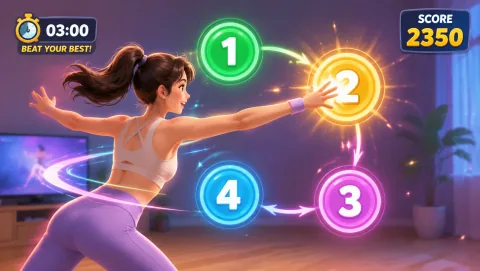
Use a console, VR title, dance game, or webcam motion game. The advantage is that attention stays on the score or challenge.
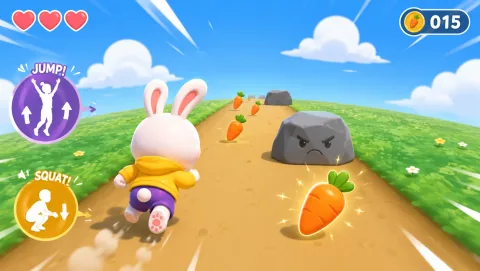
With MovePlay, you can choose a short browser game built around reaching, squatting, or other body movement. It is useful when you want to start without changing equipment or leaving home.
A sustainable active routine usually has a very low-friction version. Feedback such as skill, mood, score, or simply less sitting can be more motivating in the moment than an estimated calorie number. That is a more useful foundation for a habit than chasing perfect sessions.
Dance to three songs
Pick songs you already like. No choreography is required unless you prefer it.
Use effort that feels appropriate today; tomorrow's repeat matters more than today's heroic session.
Clean one area quickly
Vacuum one room, put away laundry, or do a ten-minute reset. Household work is not a substitute for all forms of exercise, but it is still movement.
Attach the movement to something that already happens—after a meeting, before lunch, when coffee brews, or at the end of a work block. A trigger is easier to repeat than waiting to 'feel motivated.'
Take a mobility break
Use slow shoulder, hip, ankle, and spine movements. This is better for a low-energy day than pretending you are going to do high-intensity cardio.
It helps to judge movement by repeatability before ambition. Feedback such as skill, mood, score, or simply less sitting can be more motivating in the moment than an estimated calorie number. That is a more useful foundation for a habit than chasing perfect sessions.
Run a personal skill challenge
Try ten minutes of:
- juggling;
- balance;
- jump rope if space allows;
- ball handling;
- reaction training;
- shadow boxing;
- simple dance footwork.
A skill goal gives movement something to organize around.
Walk during audio
Use a phone call, audiobook, or podcast as the time block. Stop when the call or chapter segment ends.
If the format is enjoyable, resist the urge to optimize it immediately into a complicated program.
How to make it repeatable
The useful question is what you would still do on a busy or low-energy day. Feedback such as skill, mood, score, or simply less sitting can be more motivating in the moment than an estimated calorie number. That is a more useful foundation for a habit than chasing perfect sessions.
Make ten minutes normal
You do not need to label every movement session as training. WHO guidance notes that all physical activity counts. For an inactive person, short bouts can be a practical way to build a more active day.
The useful question is not whether ten minutes qualifies as a workout. It is whether you moved when you otherwise would have remained seated.
One thing I would not ignore
Many adults need a smaller commitment, not a more sophisticated workout. Feedback such as skill, mood, score, or simply less sitting can be more motivating in the moment than an estimated calorie number. That is a more useful foundation for a habit than chasing perfect sessions.
Reduce the friction first
For adults, the hardest part is often starting rather than knowing what movement is available. Leaving room for ten-minute days makes consistency easier and does not stop you from doing more when you have momentum. That is a more useful foundation for a habit than chasing perfect sessions.
Keep the social pressure lower than the benefit
Best fit: this is useful when people can join for a short reset, understand the invitation immediately, and leave without having to explain why they are sitting out.
Limit: it is a poor choice when participation is treated as a performance, the activity competes with a serious meeting, or colleagues have very different comfort levels with cameras and movement.
If you are choosing: If you are choosing between ideas, prefer a short optional round with a personal target over a public leaderboard. The goal is an easier break, not another workplace metric.